Identity verification should not end after onboarding. A customer’s risk profile can change when they recover an account, use a new device, update personal information, add a recipient, or initiate a high-risk transaction.
In these situations, asking for another password or one-time code may confirm access to a credential, but it does not prove that the current user is the legitimate account owner. Face verification and liveness detection provide a stronger identity-binding layer by confirming both who the user is and whether a real person is present during the session.
FinAuth combines these biometric checks with device, session, behavioral, and transaction signals to support risk-based identity reverification without forcing every customer through the same process.
1. What Is Identity Reverification?
Identity reverification is the process of confirming an existing customer’s identity again after onboarding. It is typically triggered by time, policy, or a meaningful change in customer risk.
Common reverification scenarios include:
- Account recovery or password reset
- Login from a new or suspicious device
- Changes to name, address, phone number, or email
- Addition of a new payment recipient
- Large withdrawal or unusual transfer
- Long periods of account inactivity
- Detection of account takeover indicators
- Expired or updated identity documents
The objective is not necessarily to repeat the entire KYC process. A risk-based workflow selects the minimum verification action needed for the current event. Low-risk sessions may continue normally, while elevated-risk sessions may require a fresh face and liveness check.
2. Why Face Verification and Liveness Must Work Together
Face verification and liveness detection solve different problems.
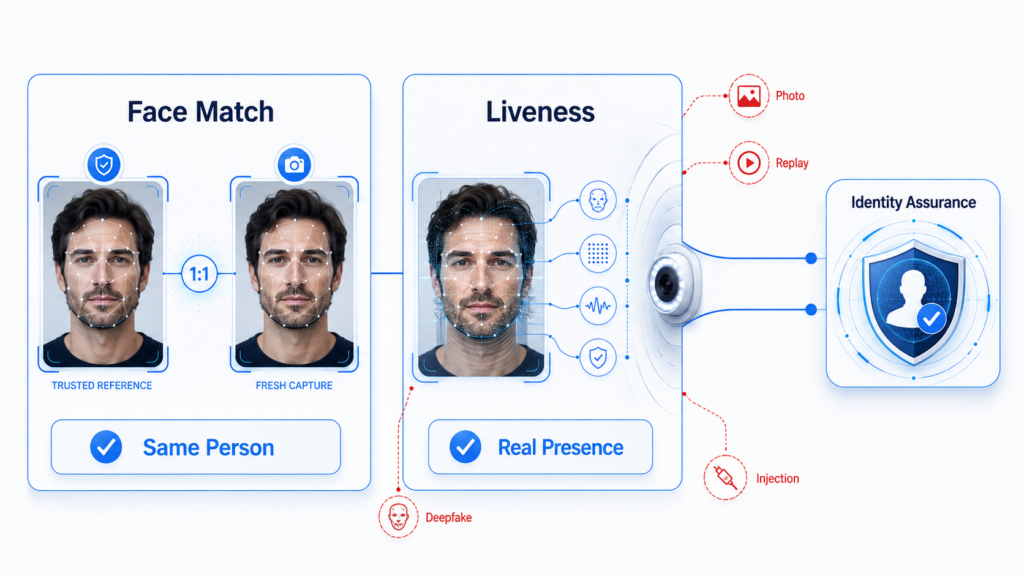
Face verification performs a 1:1 comparison between a fresh facial capture and a trusted reference image, such as the portrait collected during onboarding or extracted from a verified identity document. It answers: “Is this the same person?”
Liveness detection evaluates whether the facial capture comes from a genuine person present during the current session. It answers: “Is this a real, live interaction?”
Face matching without liveness may be vulnerable to printed photos, video replays, deepfakes, masks, and digitally injected media. Liveness without a trusted face reference can confirm genuine presence but cannot establish that the person is the correct account owner.
FinAuth combines 1:1 face verification with dual-engine Edge and Cloud liveness detection. The layered approach helps resist photo, replay, 2D and 3D mask, deepfake, and virtual-camera injection attacks during identity reverification.
3. When Should a Face and Liveness Check Be Triggered?
Reverification should be driven by risk rather than applied to every session. Excessive biometric checks can create unnecessary friction, while checks triggered too late may allow fraudsters to complete sensitive actions.
FinAuth can combine signals such as:
- Device fingerprint changes
- Proxy, VPN, emulator, or virtual-machine usage
- IP reputation and location inconsistencies
- Timezone and user-agent changes
- Unusual behavioral or input patterns
- Repeated account registration activity
- High-risk profile or transaction events
- Previous suspicious verification results
A single signal should not automatically trigger rejection. A customer may legitimately travel, replace a device, or change networks. However, several related anomalies—such as a new emulator, unusual location, rapid profile change, and high-value withdrawal—create stronger justification for biometric step-up verification.
4. How to Build a Stronger Reverification Flow
4.1 Detect the Risk Event
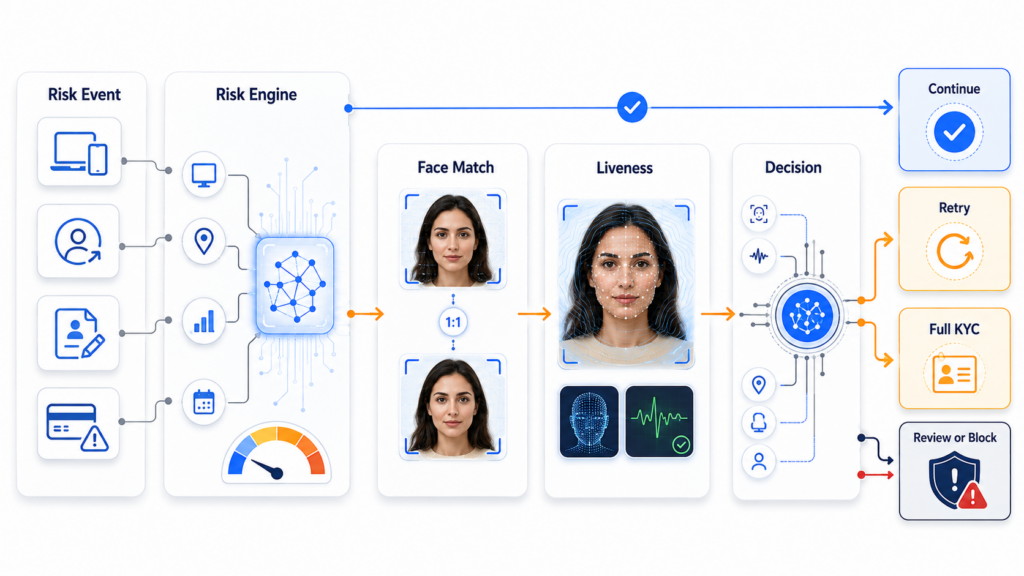
The workflow begins when an account or transaction event produces a meaningful risk change. The system should collect the event context, including device, location, behavior, transaction value, recipient, and customer history.
4.2 Select a Trusted Face Reference
The current facial capture should be compared with a reliable reference. This may be the verified document portrait or an approved facial image collected during a previous trusted session.
Reference images should be protected against unauthorized replacement. If the stored reference was created during a compromised session, later face comparisons may reinforce the wrong identity.
4.3 Capture a Fresh Face
The customer completes a new facial capture with clear alignment and sufficient image quality. Capture integrity controls should detect whether the media originates from the expected camera channel rather than a virtual camera or modified stream.
4.4 Perform Face Matching and Liveness Detection
FinAuth evaluates face-match similarity and confidence while its Edge and Cloud liveness engines analyze genuine presence and presentation-attack risks. Injection detection provides another control against generated or manipulated media entering the verification pipeline.
4.5 Combine Biometric and Contextual Risk
A successful face match should not automatically approve the action. Device risk, session anomalies, behavior, event sensitivity, and previous account activity should also enter the FinAuth Risk Engine.
The combined result can route the session into proportionate outcomes:
- Continue: Strong match, genuine liveness, and low contextual risk
- Retry: Insufficient capture quality or uncertain biometric result
- Full KYC: Significant identity changes require document verification
- Review: Conflicting signals or suspicious activity need investigation
- Block: Strong evidence of impersonation, injection, or account takeover
5. Balance Security With Customer Experience
A stronger reverification flow should create more friction for suspicious sessions, not for every customer.
Passive or low-interaction liveness can support routine step-up checks, while active challenges or full document verification can be reserved for higher-risk cases. Retry limits should prevent automated attack testing without immediately blocking genuine users who experience poor lighting or camera conditions.
FinAuth supports configurable rules, risk levels, whitelists, and A/B testing. Businesses can adjust thresholds by event type, customer segment, transaction value, and regional risk while maintaining consistent decision records for audit and investigation.
6. Protect the Full Reverification Lifecycle
Biometric security depends on more than the face algorithm. Businesses should also protect:
- The original enrollment and reference image
- The camera and media capture channel
- Biometric templates and verification results
- API requests and decision responses
- Retry, fallback, and recovery workflows
- Reviewer access and manual overrides
- Verification logs and evidence retention
FinAuth supports SDK and REST API integration across web and mobile environments, with private, hybrid, and edge deployment options for different security and data governance requirements.
7. Frequently Asked Questions
7.1 Is face verification enough for identity reverification?
No. Face verification confirms similarity to a trusted portrait, but liveness detection is needed to determine whether the capture comes from a genuine person rather than a photo, replay, deepfake, or injected stream.
7.2 Should every high-risk transaction require face verification?
Not necessarily. The decision should consider transaction value, device risk, customer history, recipient changes, location, and behavior. Risk-based orchestration applies face verification when additional identity assurance is justified.
7.3 How does FinAuth detect liveness attacks during reverification?
FinAuth combines Edge and Cloud liveness analysis with capture integrity and injection detection to identify photo, replay, mask, deepfake, and virtual-camera attack risks.
7.4 When should full KYC replace a face check?
Full KYC may be appropriate when identity information has materially changed, the trusted reference is unavailable, documents have expired, or biometric and account signals remain inconsistent after step-up verification.
8. Make Reverification Proportionate to Risk
Face and liveness checks strengthen identity reverification by reconnecting a sensitive account event to the verified customer. Their value is highest when they operate within a broader risk workflow rather than as isolated pass-or-fail checks.
By combining face verification, dual-engine liveness, injection detection, device intelligence, behavioral analysis, and configurable decisioning, FinAuth helps digital platforms protect account recovery, profile changes, and high-risk transactions while keeping trusted customer journeys efficient.