Identity fraud rarely produces one definitive warning. A stolen document may appear genuine, a deepfake may resemble the expected person, and a suspicious device may still belong to a legitimate customer.
Effective detection therefore requires multiple evidence layers. By combining identity, biometric, device, behavioral, network, and transaction signals, businesses can identify contradictions and coordinated patterns that isolated checks may miss.
FinAuth brings these signals into a unified Risk Engine, helping organizations streamline trusted users, apply additional verification to uncertain sessions, and prioritize high-risk cases.
1. Why Single-Signal Fraud Detection Is Insufficient
Individual fraud indicators often have legitimate explanations.
A new device could reflect a phone upgrade. Several capture attempts may result from poor lighting. A facial mismatch could be caused by an old document portrait. Conversely, a fraudulent session may pass an individual check when an attacker uses stolen identity data, a genuine document image, or high-quality synthetic media.
The value of multi-layer detection comes from examining how signals interact. For example:
- A new device alone may represent low risk.
- A new device combined with a digitally altered document requires additional scrutiny.
- The same device connected to multiple identities may indicate coordinated abuse.
- Repeated facial similarities across supposedly unrelated accounts may expose a fraud ring.
The final decision should reflect the combined evidence rather than one score or rule.
2. The Core Signal Layers
A multi-layer identity fraud framework should evaluate several complementary categories.
Identity and document signals
These signals establish whether the claimed identity exists and whether the evidence appears reliable:
- Document type and layout
- OCR and cross-field consistency
- MRZ or barcode consistency, where available
- Expiry and validity
- Security features
- Image manipulation and recapture indicators
- Reuse of identity attributes or documents
Face and liveness signals
Biometric evidence helps determine whether the applicant matches the trusted portrait and is genuinely present:
- 1:1 facial similarity
- Capture quality
- Presentation attack detection
- Deepfake and face-swap indicators
- Virtual-camera or injection risk
- Repeated faces across multiple identities
Device and session signals
The capture environment can reveal risk that is invisible in the submitted identity evidence:
- Device integrity
- Root, jailbreak, hook, emulator, or virtual-environment indicators
- Session and network anomalies
- Device tenure
- Repeated account creation
- One device linked to multiple identities
- Abnormal location or access patterns
Behavioral and event signals
Behavior provides context before, during, and after onboarding:
- Unusual navigation or form completion
- Automated or scripted activity
- Repeated corrections to identity data
- Abnormal retry velocity
- Account recovery shortly after enrollment
- Transactions inconsistent with the declared profile
NIST recommends layered fraud controls and identifies device fingerprinting, transaction analytics, communication-channel analysis, and behavioral analytics as relevant protections against automated, scaled, and evolving identity attacks.
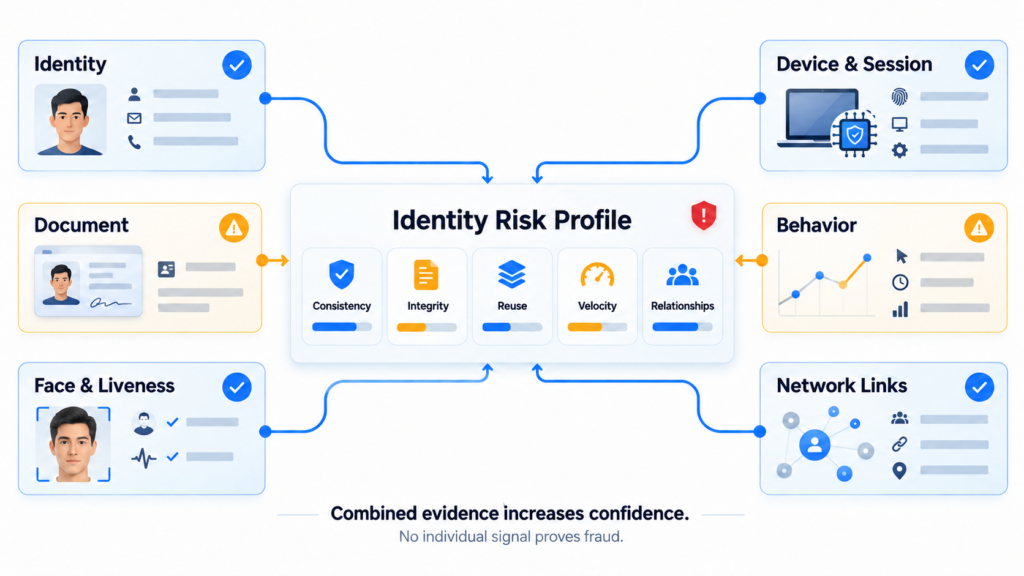
3. Correlation Creates Stronger Fraud Evidence
Multi-layer detection is not simply a checklist. The system must identify relationships and contradictions across signals.
Consider an applicant whose document passes basic layout checks. The wider session may still show that:
- The facial identity resembles users on other accounts.
- The document number has appeared with different names.
- The device has completed many verification attempts.
- Contact details overlap with unrelated identities.
- Several accounts share one beneficiary.
- Activity follows the same timing and transaction pattern.
Each observation may be inconclusive independently. Together, they may reveal synthetic identity creation, account farming, identity reuse, or an organized fraud ring.
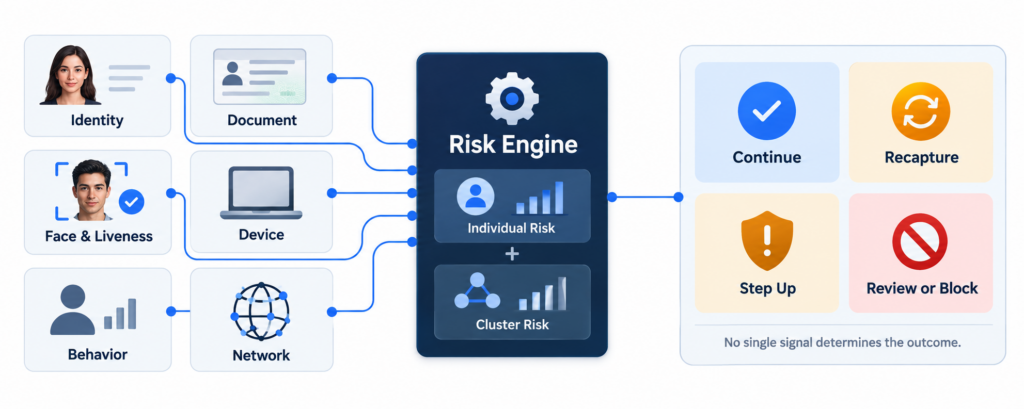
FinAuth can combine current-session evidence with historical relationships. Its Risk Engine can assess both individual risk, which concerns the applicant and current event, and cluster risk, which reflects connections across accounts, faces, documents, devices, and other entities.
4. Separate Quality Problems From Fraud Indicators
A failed check does not always indicate malicious activity.
Blur, glare, weak connectivity, damaged documents, and old cameras can produce unreliable results for genuine users. These problems should normally trigger specific guidance or controlled recapture.
Security indicators require a different response. Examples include document manipulation, repeated identity reuse, injected media, device tampering, implausible behavioral velocity, or coordinated links to known high-risk accounts.
FinAuth can separate these categories:
- Quality issue: Guide the user and recapture the evidence.
- Uncertain evidence: Request an additional identity signal.
- Elevated combined risk: Apply stronger document, facial, or liveness checks.
- Strong coordinated risk: Route to investigation, restriction, or rejection.
This approach reduces unnecessary rejection without treating every technical failure as harmless.
5. Build Risk-Based Decisioning Around Combined Evidence
A practical workflow should normalize incoming signals and evaluate their reliability, severity, recency, and relationships.
FinAuth can orchestrate the process through four broad risk bands:
Low risk: Consistent identity evidence, genuine presence, trusted capture conditions, and normal behavior. The user can continue automatically.
Medium risk: Correctable quality issues, a new device, or an isolated inconsistency. The workflow can request recapture or another signal.
High risk: Multiple related anomalies, document manipulation indicators, suspicious device conditions, or abnormal velocity. The session can receive step-up verification or priority review.
Critical risk: Strong spoofing, injection, coordinated identity reuse, or connections to confirmed fraud. The account or event can be blocked or restricted according to policy.
NIST states that fraud-management programs should support identification, detection, investigation, reporting, and resolution. It also requires organizations to monitor the effectiveness of fraud controls and establish documented actions for failed checks.
6. Preserve Explainability and Human Oversight
Multi-layer risk decisions should remain reviewable.
Investigators need to understand which evidence influenced the outcome, whether the signals are independent, and how strongly they support the suspected fraud pattern. A useful case view should show:
- Triggered signals and their severity
- Source and timestamp
- Related accounts or entities
- Historical changes
- Contradictory evidence
- Actions already completed
- Recommended next step
Automated decisions should also include recovery and review paths. NIST requires manual review before declining enrollment solely on the basis of a 1 biometric identification result, recognizing that automated matches can produce false positives.
7. Measure Detection Quality Across the Full Workflow
Teams should evaluate both security and customer impact.
Useful metrics include:
- Fraud detected by each signal layer
- Fraud detected only through combined signals
- False-positive and false-rejection rates
- Recapture and step-up frequency
- Manual-review volume and resolution time
- Confirmed fraud by risk band
- Shared-device, face, and document link rates
- Fraud discovered after onboarding
- Performance by market, document type, and device environment
Signal weights and decision policies should be reviewed as attack methods, customer populations, and operational conditions change.
8. Multi-Layer Identity Fraud Detection Q&A
What is multi-layer identity fraud detection?
It is an approach that combines identity, document, biometric, device, behavioral, network, and event evidence instead of relying on one verification result.
Why are device signals important in identity verification?
They help identify scaled account creation, compromised environments, emulators, repeated identities, and coordinated activity that may not be visible in a document or facial comparison.
Can one suspicious signal prove identity fraud?
Usually not. A signal may have a legitimate explanation. FinAuth evaluates its severity and reliability alongside other evidence before assigning risk or selecting an action.
How does FinAuth detect coordinated identity fraud?
FinAuth can analyze relationships among accounts, faces, documents, devices, contact details, beneficiaries, and historical events. Its Risk Engine combines individual and cluster-level evidence to identify suspicious overlaps.
Does multi-layer detection increase onboarding friction?
It can reduce friction when used correctly. Trusted sessions can proceed automatically, while recapture, step-up verification, or review is reserved for cases with missing, inconsistent, or elevated-risk evidence.
9. Conclusion
Multi-layer identity fraud detection provides stronger protection than isolated document, facial, or device checks. Its value comes from identifying contradictions, relationships, and coordinated patterns across the complete customer journey.
By integrating document verification, Face Verification, Liveness Detection, device intelligence, behavioral analysis, network links, and risk-based orchestration, FinAuth helps businesses approve trusted users efficiently while focusing investigation on the sessions and clusters that present the strongest combined risk.