Adverse media screening can reveal customer risks that sanctions, PEP, and watchlist databases do not yet contain. However, broad news searches often return duplicated articles, unrelated people, low-quality allegations, old events, and negative stories with little compliance relevance.
AI-based classification helps convert this unstructured content into structured risk signals. It can identify the subject, classify the alleged activity, assess relevance and severity, consolidate related coverage, and route material cases for review. The objective is not to let AI determine guilt. It is to help compliance teams focus on evidence that may materially affect customer risk.
1. What Is Adverse Media Classification?
Adverse media screening searches public information for reports that may indicate financial crime, regulatory, reputational, or integrity risk involving a customer or related party.
Potential categories may include:
- Money laundering or terrorist financing
- Fraud and identity crime
- Bribery and corruption
- Sanctions evasion
- Organized crime
- Cybercrime
- Regulatory enforcement
- Serious misconduct relevant to the business relationship
Classification assigns retrieved content to defined risk categories and adds context such as subject relevance, event date, source type, allegation status, and severity.
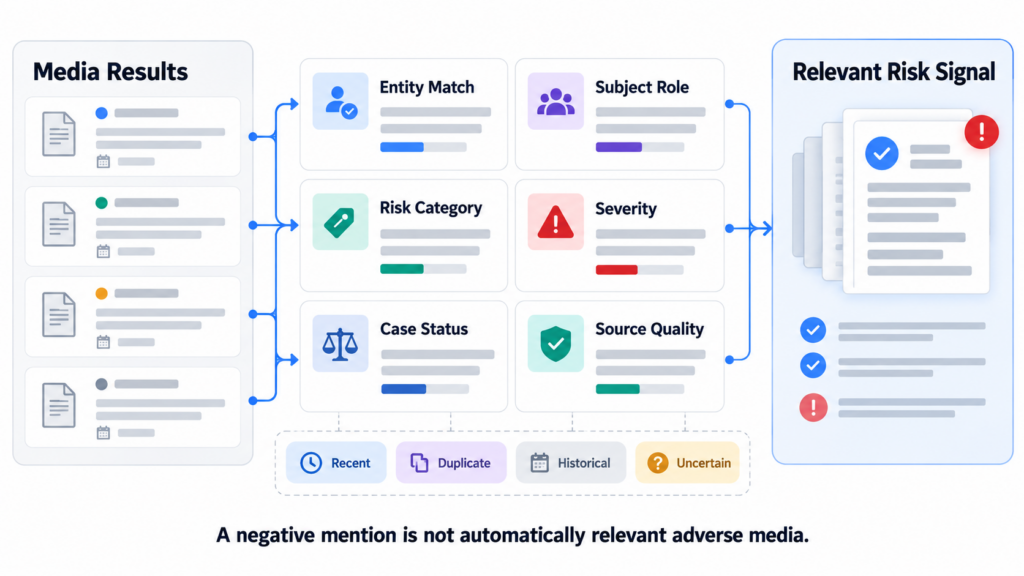
A negative article is not automatically a relevant risk signal. The system must determine whether the article concerns the correct person or entity, whether the reported conduct falls within policy, and whether the information is sufficiently credible and current to affect the customer’s risk assessment.
2. Why Keyword Matching Creates Excessive Noise
Simple searches may treat every appearance of a customer’s name near a negative term as an alert. This creates several problems:
Name ambiguity: Different people and companies may share the same or similar name.
Context failure: An article may mention the customer as a victim, witness, lawyer, regulator, or unrelated third party rather than the subject of misconduct.
Duplicate coverage: Many publishers may repeat the same underlying event.
Language variation: The same conduct may be described using different terminology, scripts, translations, or local expressions.
Historical noise: Old allegations may continue to appear even after dismissal, acquittal, correction, or resolution.
Weak source quality: Anonymous posts, copied content, and unsupported claims should not carry the same weight as official records or established reporting.
AI can reduce this noise by analyzing meaning and relationships rather than relying only on matching terms.
3. How AI Prioritizes Relevant Adverse Media
A practical classification workflow can evaluate several dimensions.
Entity resolution: Determine whether the article refers to the screened customer by comparing names, aliases, location, occupation, company relationships, age, and other available attributes.
Role analysis: Identify whether the customer is the alleged actor, a connected party, a victim, or merely mentioned.
Risk taxonomy: Map the reported conduct to the organization’s approved adverse-media categories.
Severity: Distinguish minor or peripheral concerns from allegations involving serious financial crime, organized activity, enforcement action, or substantial customer harm.
Status: Separate allegations, investigations, charges, court decisions, regulatory findings, dismissals, and acquittals.
Recency: Consider when the underlying event occurred, not only when an article was republished.
Source assessment: Evaluate whether information comes from an official authority, established publication, specialist source, or lower-confidence channel.
Deduplication: Group articles describing the same event so repeated reporting does not artificially increase risk.
These outputs should remain explainable. Reviewers need to see why an article was linked to the customer, which category was assigned, and which evidence influenced priority.
4. Connect Media Results to Verified Customer Identity
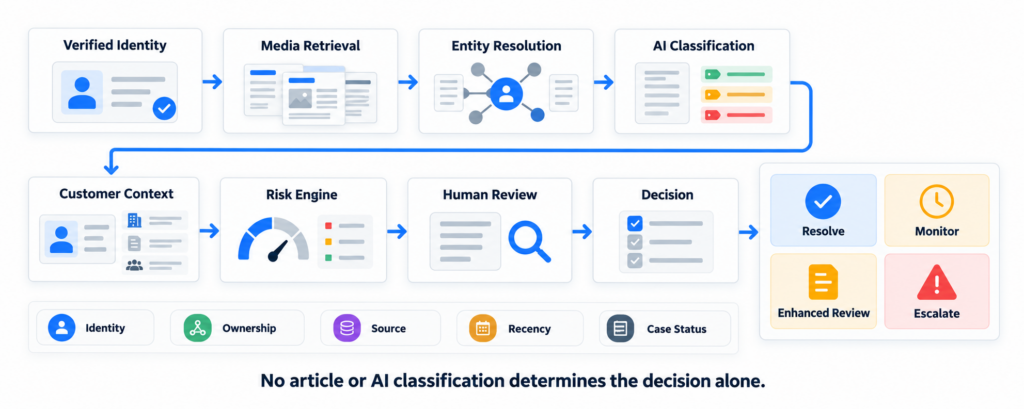
Accurate classification depends on knowing who the customer actually is. Screening an unverified name can connect media about the wrong person, while criminals may intentionally submit altered identity data to avoid detection.
FinAuth strengthens the identity layer through:
- Document OCR and structured data extraction
- Document authenticity and manipulation analysis
- Face Verification and Liveness Detection
- Device and session intelligence
- Customer and account-linking signals
Verified names, dates of birth, nationality, address, document attributes, and facial identity can support stronger entity resolution. For organizations, adverse media should also be assessed against directors, representatives, beneficial owners, and other relevant connected parties.
FATF emphasizes access to adequate, accurate, and up-to-date beneficial ownership information because criminals can conceal activity behind legal persons and complex ownership structures.
5. Build Risk-Based Priority Bands
Adverse media should contribute to a combined customer-risk assessment rather than trigger an automatic rejection.
A practical workflow may use four priority bands:
- Low relevance: Weak entity match, irrelevant context, duplicate coverage, or conduct outside policy. Resolve or archive with a recorded reason.
- Monitor: Relevant but lower-severity, historical, or unresolved information. Continue monitoring according to policy.
- Enhanced review: Credible and relevant reporting that requires clarification, source-of-funds checks, ownership analysis, or additional evidence.
- Priority escalation: Strong entity alignment combined with serious, recent, or repeated allegations, official action, or other high-risk indicators.
The EBA’s ML/TF Risk Factors Guidelines require firms to consider relevant risk factors holistically and apply customer due diligence proportionate to the identified risk. They also recognize adverse media checks within risk-based enhanced due diligence rather than as an indiscriminate control for every case.
FinAuth’s Risk Engine can combine an external adverse-media assessment with verified identity, ownership, screening, document, device, behavioral, and transaction signals. No article, keyword, or AI classification should determine the outcome alone.
6. Preserve Human Oversight and Auditability
AI should prioritize evidence, not make unsupported legal or factual conclusions.
Reviewers should receive:
- The article and original source
- Publication date and underlying event date
- Matched customer attributes
- Assigned risk category and confidence
- The customer’s role in the story
- Allegation or case status
- Related and duplicate articles
- Contradictory or exculpatory information
- Previous decisions and monitoring history
Every automated resolution or escalation should retain its inputs, model or rule version, reasoning, reviewer action, and final disposition. This supports quality monitoring and helps identify inconsistent classifications or systematic source bias.
7. Measure Classification Quality
Useful operating metrics include:
- Articles retrieved per customer
- Confirmed entity-match rate
- Duplicate reduction rate
- Relevant-risk rate
- False-positive and false-negative findings
- Classification accuracy by category and language
- Manual-review volume
- Average investigation time
- Reviewer override rate
- Cases changed by newer information
Teams should regularly test the system against reviewed cases and update taxonomies, sources, entity-resolution rules, and priority thresholds as risks and media environments change.
8. Adverse Media Classification Q&A
What is AI-based adverse media classification?
It uses language and entity-analysis models to organize media into risk categories, identify the relevant subject, assess context, and prioritize content for compliance review.
Is adverse media proof of criminal activity?
No. Media may contain allegations, incomplete facts, inaccurate reporting, or outdated information. Reviewers must consider source quality, case status, contradictory evidence, and applicable policy.
How can businesses reduce adverse media false positives?
Use verified customer attributes, entity resolution, role analysis, event-level deduplication, source assessment, multilingual processing, and clearly defined risk categories.
How does FinAuth support adverse media workflows?
FinAuth verifies customer identity and can combine external adverse-media results with document, face, liveness, device, ownership, behavioral, and transaction risk through its Risk Engine. This helps route cases to resolution, monitoring, enhanced review, or priority escalation.
9. Conclusion
AI-based classification makes adverse media screening more operationally useful by separating simple name mentions from credible, relevant risk evidence. Its value comes from entity resolution, contextual classification, source assessment, event consolidation, and explainable prioritization.
Combined with verified identity and broader customer-risk signals, FinAuth helps compliance teams reduce noise while directing attention to adverse information that may require meaningful action.