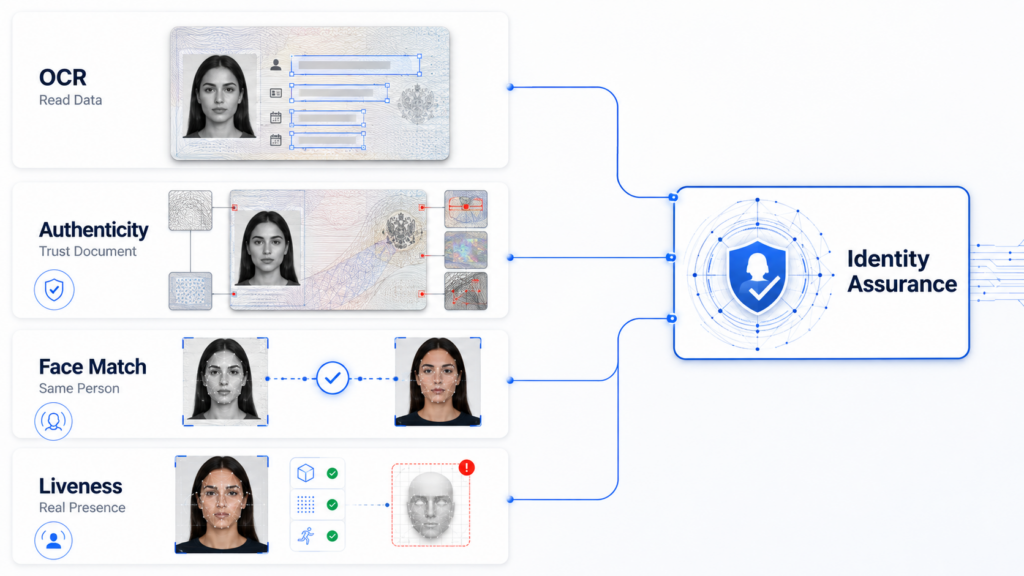
Digital identity verification must answer two different questions: Is the submitted identity document genuine, and is the person presenting it the legitimate document holder?
OCR can extract readable identity information, but readable data does not prove that a document is authentic. Face verification can confirm similarity between two portraits, but it cannot determine whether the reference document has been altered or stolen. A stronger eKYC workflow combines document authenticity checks, face verification, liveness detection, and contextual risk signals.
FinAuth brings these capabilities into one risk-based verification flow, helping digital businesses detect manipulated documents, impersonation attempts, and AI-powered identity fraud without creating unnecessary friction for legitimate applicants.
1. Why Document and Face Checks Must Work Together
Document verification and face verification address different parts of identity risk.
Document authenticity checks analyze whether the submitted credential is structurally and visually trustworthy. Face verification determines whether a fresh facial capture matches the portrait associated with that credential.
Using either capability alone leaves important gaps:
- A genuine document may be stolen and presented by another person.
- A manipulated document may contain a portrait that matches the fraudster.
- A readable document may have altered identity fields.
- A matching face may come from a photo, replay, deepfake, or injected stream.
- A genuine user may submit a poor-quality document that creates uncertain results.
The combined workflow binds document authenticity, identity ownership, and genuine presence into one decision.
2. What Document Authenticity Checks Should Detect
A document can pass OCR while still being fraudulent. OCR determines what the document says; authenticity analysis determines whether the visual evidence can be trusted.
FinAuth uses multilingual OCR and Large Visual Model-based document understanding to evaluate document structure, fields, textures, and visual relationships. Relevant checks include:
- Document type and format consistency
- Required field presence
- Front-and-back information consistency
- Portrait and identity-field placement
- Expiry and validity information
- Photoshop or editing traces
- Splicing and field replacement
- Recaptured or re-photographed documents
- Screen displays and screenshots
Cross-field validation adds another layer. The extracted name, date of birth, document number, and expiry date can be compared with machine-readable data, the opposite side of the document, and information entered by the applicant.
A successful OCR result should therefore never be treated as automatic proof of authenticity.
3. How Face Verification Establishes Identity Ownership
After the document passes initial quality and authenticity checks, the portrait becomes a trusted identity reference.
FinAuth performs 1:1 face verification by comparing the document portrait with a fresh facial capture. The result includes a similarity score and confidence information that can be evaluated according to the business scenario.
Face verification helps identify:
- Stolen documents presented by another person
- Portrait replacement inside an identity document
- Applicants using another person’s credentials
- Inconsistent identities across repeated applications
- Account recovery attempts by an unauthorized user
However, a face match alone cannot confirm genuine presence. A fraudster may present a high-quality photo, replayed video, synthetic face, or digitally injected media that resembles the document portrait.
FinAuth therefore combines face matching with dual-engine Edge and Cloud liveness detection. The liveness layer analyzes genuine presence while helping resist photo, replay, 2D and 3D mask, deepfake, and virtual-camera injection attacks.
4. Building a Combined eKYC Workflow
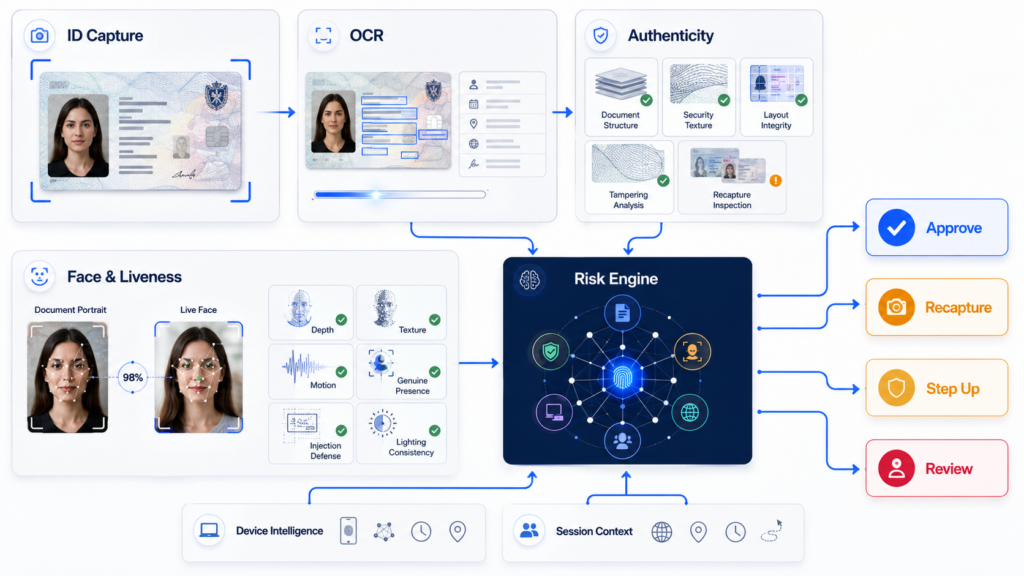
A complete document-and-face verification flow can be structured into six stages.
4.1 Guided Document Capture
The user submits the identity document through a guided capture process. Quality checks evaluate blur, glare, cropping, obstruction, orientation, and image completeness before deeper analysis begins.
4.2 OCR and Data Extraction
The system identifies the document type and extracts identity fields into structured data. This information can be standardized and compared with the onboarding form.
4.3 Document Authenticity Analysis
FinAuth evaluates the document for structural inconsistencies, editing traces, splicing, recapture, screen display, screenshots, and other fraud indicators.
4.4 Fresh Face and Liveness Capture
The applicant provides a fresh facial capture. Capture integrity and liveness analysis help confirm that the media originates from a genuine user rather than an attack source.
4.5 Face Match
The fresh face is compared with the document portrait. The system evaluates similarity and confidence while accounting for image quality and facial variation.
4.6 Combined Risk Decision
Document, OCR, face, liveness, device, session, and behavioral results enter the FinAuth Risk Engine. The workflow can then approve trusted applicants, request another capture, apply additional verification, or route suspicious cases to review.
5. Use Multi-Signal Risk Decisioning
No single verification result should determine the outcome alone.
For example, a strong face match should not override clear evidence of document manipulation. Likewise, a minor document-quality issue should not automatically cause rejection when the remaining identity and contextual signals are consistent.
FinAuth combines configurable rules with machine learning to classify sessions into proportionate risk levels:
- Low risk: Authentic document, consistent data, strong face match, genuine liveness, and normal session context
- Medium risk: Uncertain image quality, borderline match, field mismatch, or unusual device signals
- High risk: Manipulated document, identity conflict, failed liveness, deepfake indicator, or injection attempt
- Critical risk: Multiple strong fraud indicators or connections to previously suspicious activity
Based on the result, businesses can approve, request recapture, trigger step-up verification, review, or block the application.
6. Reduce Friction Without Weakening Security
Stronger eKYC does not require every applicant to complete the most intensive verification path.
Trusted users can move through document, face, and passive liveness checks with limited interaction. Active challenges, additional documents, or manual review can be reserved for sessions with elevated risk.
Businesses should also configure:
- Quality-based recapture before risk rejection
- Separate thresholds for onboarding and high-risk actions
- Retry limits that prevent automated attack testing
- Regional document and policy rules
- Clear reason codes for escalated decisions
- Audit logs for verification evidence and overrides
FinAuth supports SDK and REST API integration across web and mobile channels, as well as private, hybrid, and edge deployment options. Configurable rules, whitelists, and A/B testing help businesses balance fraud prevention, compliance, and onboarding conversion.
7. Frequently Asked Questions
7.1 Is OCR the same as document verification?
No. OCR extracts text and structured fields. Document verification evaluates whether the document is valid, consistent, and free from signs of manipulation or recapture.
7.2 Can face verification detect a fake identity document?
Face verification can identify a mismatch between the document portrait and the applicant, but it does not replace document authenticity analysis. A manipulated document may contain the fraudster’s own portrait.
7.3 Why is liveness detection required after face matching?
Liveness detection helps confirm that the facial capture comes from a genuine person present during the session rather than a photo, replay, mask, deepfake, or injected video stream.
7.4 How does FinAuth combine document and biometric verification?
FinAuth connects multilingual OCR, document authenticity checks, 1:1 face verification, dual-engine liveness, device intelligence, behavioral analysis, and risk decisioning within one eKYC workflow.
8. Build Identity Assurance Across Every Layer
A readable document is not necessarily authentic, and a matching face does not automatically prove genuine presence. Reliable eKYC requires the document, identity data, document portrait, fresh face, capture channel, and session context to support the same conclusion.
By combining LVM-powered document analysis with face verification, Edge and Cloud liveness, injection detection, and multi-signal risk decisioning, FinAuth helps digital businesses build stronger identity assurance from onboarding through later high-risk account events.