Facial comparison converts the similarity between a trusted reference image and a fresh facial capture into a confidence score. A decision threshold determines whether that score is accepted, rejected, or routed for additional verification.
Setting the threshold too low can increase false matches and identity fraud exposure. Setting it too high can reject genuine users, increase retries, and reduce onboarding conversion. The right approach is therefore not to search for one universal score, but to combine a validated facial comparison threshold with contextual risk signals and proportionate actions.
1. What Does a Facial Comparison Threshold Mean?
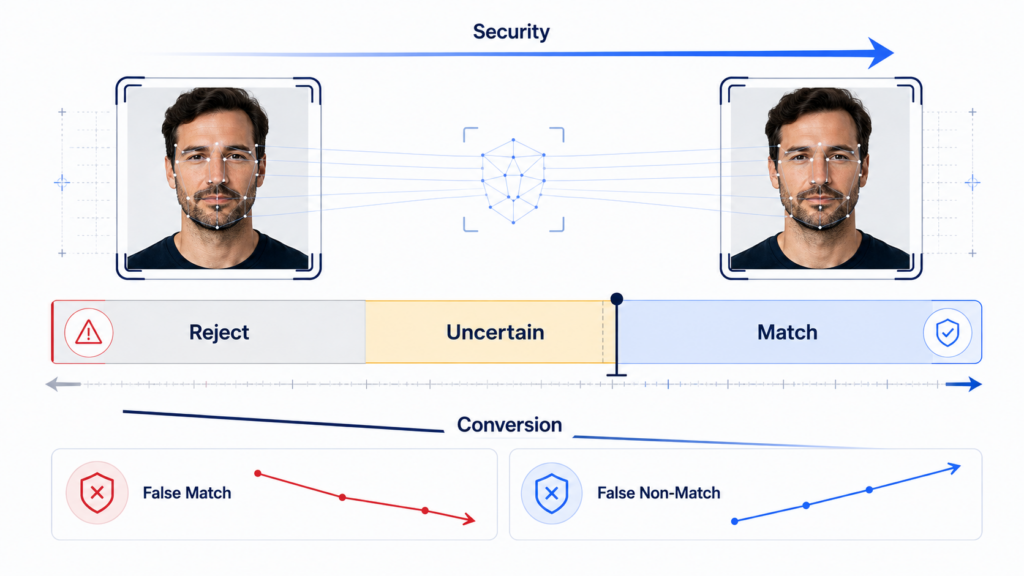
In 1:1 Face Verification, the system compares a user’s live facial capture with a trusted portrait, such as the image extracted from an identity document. The resulting similarity score indicates how strongly the two images appear to represent the same person.
The threshold converts that score into an operational outcome:
- Scores clearly above the threshold can proceed.
- Borderline scores may require recapture or step-up verification.
- Scores below the threshold may be reviewed or rejected.
Two performance measures are central to threshold design:
False Match Rate (FMR): How often two different people are incorrectly accepted as the same person.
False Non-Match Rate (FNMR): How often two images of the same person fail to match.
Increasing the threshold usually reduces false matches but may increase false non-matches. NIST evaluates facial verification algorithms by measuring FNMR at specified FMR levels, illustrating why security and user acceptance must be assessed together. NIST FRTE 1:1 Verification
2. Why One Threshold Cannot Solve Every Business Risk
A digital bank opening a basic account and a payment platform approving a high-value withdrawal do not face the same consequences if an impostor is accepted. Their broader verification policies should therefore apply different levels of assurance.
However, risk-based verification does not necessarily mean changing the biometric threshold for every user. A stronger design keeps the facial comparison model technically consistent while changing the workflow around the result.
For example:
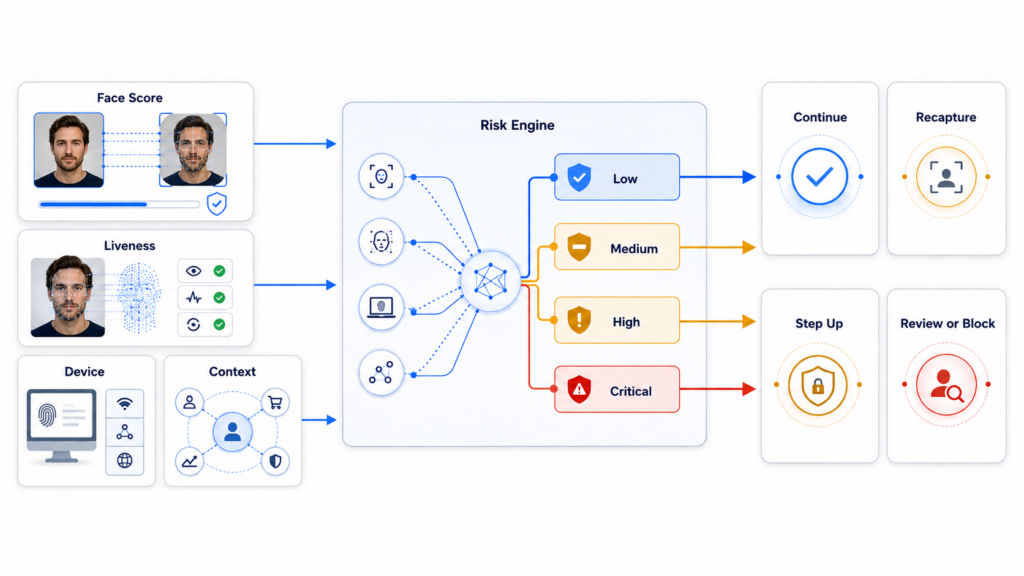
- A low-risk onboarding session with a strong match and trusted device may continue automatically.
- A medium-risk session with a borderline match may require another capture.
- A high-risk transaction may require Face Verification, Liveness Detection, and device checks even when the match score is acceptable.
- A critical-risk session with injection indicators should be blocked or reviewed regardless of facial similarity.
Thresholds should never be adjusted by demographic group. Instead, organizations should test performance across the expected user population, devices, capture conditions, and markets. NIST similarly requires biometric performance and demographic impacts to be assessed under conditions representative of the operational environment. NIST SP 800-63A
3. Factors That Affect Facial Comparison Scores
A low score does not always indicate fraud. It may result from poor capture quality, changes in appearance, or weak reference images.
Common factors include:
Image quality: Blur, glare, low resolution, compression, shadows, and extreme camera angles can reduce facial detail.
Reference quality: An old, damaged, recaptured, or low-resolution document portrait may provide a weak comparison baseline.
Appearance changes: Aging, facial hair, cosmetics, glasses, and other legitimate changes may affect similarity.
Capture integrity: A visually convincing deepfake or injected video stream may produce a high facial similarity score while still representing a fraudulent session.
Algorithm and operating environment: Performance varies by algorithm, camera, user population, and image source. NIST’s quality evaluation shows that image quality assessment and recognition errors are related, but quality scoring alone does not perfectly predict false non-matches. NIST FATE Quality
This is why FinAuth does not treat a face-match score as standalone proof. Its Risk Engine can combine Face Verification with document authenticity, Edge and Cloud Liveness Detection, injection detection, device intelligence, session context, and behavioral risk.
4. Building Risk-Based Decision Bands
A practical facial verification workflow should use decision bands rather than a single pass-or-fail boundary.
Low risk: Strong facial match, genuine presence, trusted document, and normal device signals. The user can continue automatically.
Medium risk: Acceptable or borderline match with a quality issue or new device. The system may request recapture, active liveness, or an additional identity check.
High risk: Weak facial match combined with unusual behavior, suspicious device characteristics, or high-value activity. The session should receive stronger verification or manual review.
Critical risk: Deepfake, injection, document manipulation, repeated mismatches, or coordinated fraud indicators. The business may block the session or place it in a priority investigation queue.
With FinAuth, these bands can be configured around the customer’s product, transaction value, account history, device risk, and operational policy. The facial comparison threshold remains one important control, but the final decision reflects the full risk context.
5. How to Optimize Security and Conversion
Threshold configuration should be based on representative production data rather than laboratory accuracy alone.
Teams should measure:
- FMR and FNMR at candidate thresholds
- First-attempt and eventual verification success
- Recapture and abandonment rates
- Manual review volume
- Confirmed fraud passing each score band
- Performance by document type, device, market, and capture condition
Borderline sessions should also have a recovery path. Guided recapture can resolve blur, glare, poor framing, and facial occlusion without weakening the security threshold. When the image is usable but risk remains elevated, FinAuth can route the session through stronger Liveness Detection or additional document verification.
Regular monitoring is essential because fraud methods, user devices, document coverage, and transaction patterns change over time. Thresholds and surrounding policies should be retested whenever the operating environment changes materially.
6. Facial Comparison Threshold Q&A
What is a good threshold for facial comparison?
There is no universal score because similarity scales vary across algorithms. A suitable threshold should be calibrated using the required false match rate, acceptable false non-match rate, and representative production data.
Should high-risk users receive a higher face-match threshold?
A safer approach is often to maintain a validated biometric threshold and add stronger controls around high-risk sessions. FinAuth can require Liveness Detection, document verification, device analysis, or manual review based on the combined risk.
Can a high face-match score prove that the user is genuine?
No. A high score indicates facial similarity, not genuine presence or capture integrity. Deepfakes and injection attacks make Liveness Detection and injection detection essential complementary controls.
How does FinAuth reduce false rejections?
FinAuth combines quality checks, guided recapture, Face Verification, Edge and Cloud Liveness Detection, and contextual risk decisioning. Genuine users can recover from capture problems while suspicious sessions receive proportionate verification.
7. Conclusion
Facial comparison thresholds must balance false-match risk with genuine-user conversion. The strongest strategy is not a universal score or a face-only decision. It is a layered workflow that combines a validated threshold with image quality, liveness, capture integrity, device risk, and business context.
FinAuth enables this multi-signal approach, helping organizations automate trusted sessions, step up uncertain cases, and prioritize genuine identity threats.