Digital identity verification systems may process thousands or millions of sessions, but the sessions do not carry equal risk. A customer using a trusted device with consistent identity evidence should not receive the same treatment as a session involving a manipulated document, abnormal device environment, weak face match, and suspected injection attack.
Identity fraud risk scoring converts multiple verification signals into a consistent measure of session risk. The score helps businesses prioritize manual review, trigger step-up verification, and allow trusted users to continue with less friction.
FinAuth supports this approach through Document Verification, Face Verification, Liveness Detection, Device and Session Risk, Behavioral Risk, and a configurable Risk Engine.
1. What Is an Identity Fraud Risk Score?
An identity fraud risk score represents the likelihood that a verification session requires additional attention. It is usually calculated from multiple signals collected during onboarding, login, account recovery, profile changes, or sensitive transactions.
A higher score does not automatically prove fraud. It indicates that the available evidence contains more uncertainty, inconsistency, or suspicious activity.
For example, a session may receive a higher risk score when:
- The document structure does not match the expected template
- Extracted identity fields are inconsistent
- The document shows signs of editing or recapture
- Face-match confidence is below the expected range
- Liveness or injection detection identifies an attack
- The device environment appears manipulated
- The same identity is linked to multiple suspicious sessions
- User behavior differs significantly from historical patterns
The score should guide the next action rather than function as an isolated final verdict.
2. Which Signals Should Contribute to Risk Scoring?
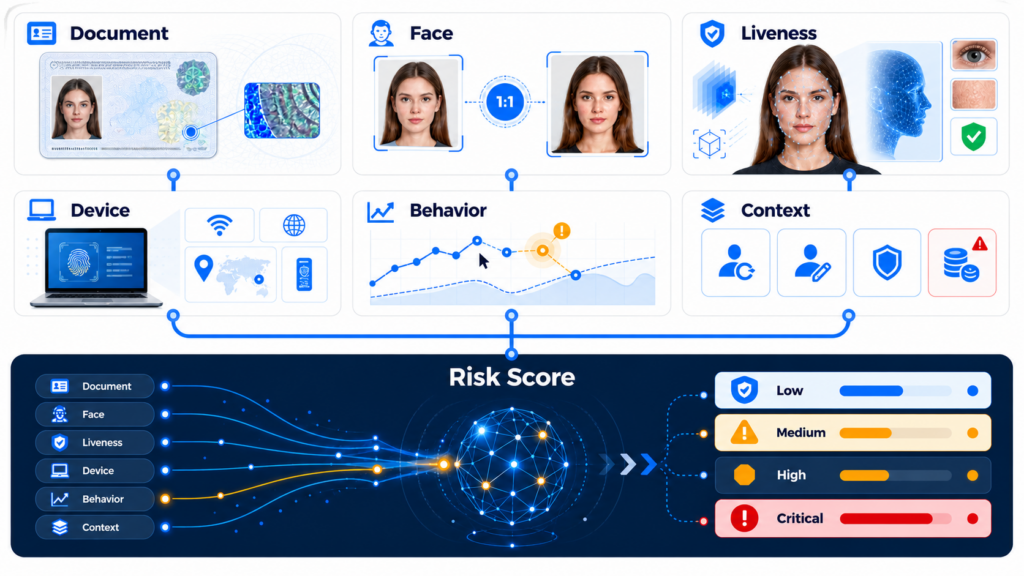
A scalable scoring model should combine identity, biometric, device, behavioral, and contextual evidence.
Document signals include image quality, document type, validity, OCR confidence, field consistency, expiry status, and authenticity indicators. FinAuth Document Verification can identify signs of Photoshop editing, image splicing, recapture, screen display, and screenshot use.
Face-match signals measure whether the document portrait or trusted reference image corresponds to the fresh facial capture.
Liveness signals evaluate genuine presence and capture integrity. FinAuth Edge and Cloud Liveness Detection helps defend against printed photos, video replays, 2D and 3D masks, deepfakes, virtual cameras, and media injection.
Device and session signals can identify unfamiliar devices, emulators, rooted or jailbroken environments, network anomalies, unusual locations, and suspicious session changes.
Behavioral signals may include abnormal interaction paths, repeated retries, automation patterns, rapid account switching, or behavior inconsistent with previous sessions.
Business context reflects the sensitivity of the requested action. Opening an account, changing a recovery method, adding a new recipient, and initiating a large withdrawal may require different thresholds.
3. Why No Single Signal Should Determine the Score
Individual signals are often ambiguous.
A new device may belong to a legitimate customer. A low-quality document may result from poor lighting rather than fraud. A face-match score may decline because of aging, appearance changes, pose, or capture quality.
At the same time, one apparently successful check does not make the entire session trustworthy. A readable document may be manipulated. A strong face match may come from a deepfake or injected video stream. A live person may still be presenting another person’s document.
FinAuth Risk Engine evaluates relationships between signals. A new device combined with an abnormal location, repeated identity attempts, document manipulation, and failed liveness provides much stronger fraud evidence than any one event alone.
Multi-signal decisioning helps reduce both missed fraud and unnecessary rejection of genuine users.
4. From Raw Signals to Risk Levels
Risk scoring typically involves four stages.
First, verification modules generate raw results, confidence values, quality indicators, and reason codes.
Second, the platform standardizes these results so signals with different formats can be evaluated together. A document authenticity result, face-match confidence, and device anomaly cannot be compared directly without normalization.
Third, the Risk Engine applies weights, rules, and signal relationships. Strong attack indicators may carry more weight than minor quality issues. Some combinations—such as a manipulated environment plus injection evidence—may raise risk more sharply than two unrelated low-severity warnings.
Finally, the score is mapped to operational risk levels:
- Low: evidence is consistent and no meaningful fraud indicators are present.
- Medium: some uncertainty exists and additional verification may be needed.
- High: multiple suspicious signals or a strong fraud indicator is present.
- Critical: the session contains attack evidence that may justify immediate review or blocking.
Thresholds should be calibrated using genuine-user performance, confirmed fraud, review results, and business risk tolerance.
5. How Risk Scores Prioritize Verification Sessions
The primary value of risk scoring is operational prioritization.
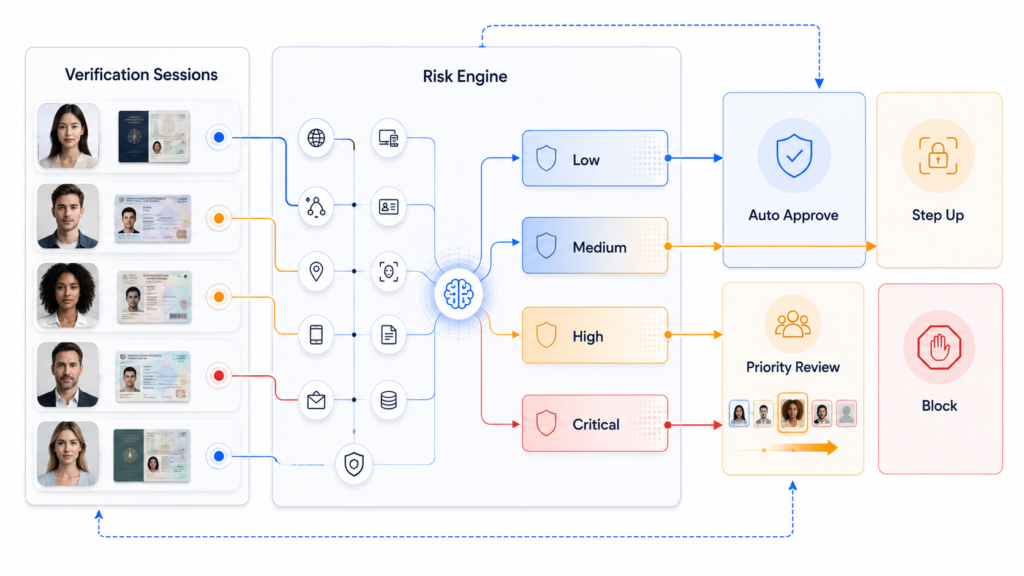
Low-risk sessions can be approved automatically, reducing friction and processing costs. Medium-risk sessions may trigger recapture, another document, an OTP, or face and liveness verification. High-risk sessions can be placed earlier in the review queue with their strongest risk evidence displayed to the analyst. Critical sessions may be blocked or escalated immediately.
FinAuth can return both a risk level and supporting evidence. Instead of showing reviewers only a number, the workflow can explain that the score was driven by document manipulation, device anomalies, failed liveness, identity linkage, or another relevant signal.
This evidence-based approach helps reviewers make faster and more consistent decisions.
6. Designing an Effective Review Queue
A review queue should not simply sort sessions by score. It should also consider urgency, transaction value, regulatory obligations, customer impact, and the type of suspected fraud.
A high-risk account recovery may require faster attention than a low-value onboarding case. A suspected injection attack may need a different review process from a blurred document.
FinAuth can help businesses route sessions using combinations of risk level, reason code, workflow stage, and business context. Analysts can receive the identity evidence most relevant to the case rather than searching across disconnected systems.
Review results should then feed back into policy tuning. Confirmed fraud, false positives, successful appeals, and recapture outcomes can reveal whether thresholds or signal weights require adjustment.
7. How to Measure Risk Scoring Performance
A risk-scoring system should be evaluated through both security and customer-experience metrics.
Useful measures include:
- Confirmed fraud rate by risk level
- Genuine-user approval rate
- Step-up and recapture frequency
- False rejection rate
- Manual review volume
- Review completion time
- Fraud detection after approval
- Score distribution by market and document type
Teams should also monitor score drift. Changes in customer populations, device environments, fraud tactics, and document versions can affect how signals behave over time.
FinAuth Audit and Compliance capabilities can support traceability by preserving verification results, decision evidence, and policy outcomes.
8. Frequently Asked Questions
Q1. Is a high identity fraud risk score proof of fraud?
No. It indicates that the session contains stronger uncertainty or suspicious evidence. The appropriate response may be step-up verification, review, or blocking depending on the evidence and business context.
Q2. What is the difference between a risk score and a risk level?
A risk score is a more granular numerical or relative measure. A risk level groups score ranges into operational categories such as Low, Medium, High, and Critical.
Q3. Can one failed liveness check create a high-risk result?
It can, depending on the reason. A quality-related failure may justify retrying, while detected injection or deepfake evidence may carry substantially more risk. FinAuth distinguishes quality issues from attack indicators.
Q4. How does FinAuth reduce unnecessary manual review?
FinAuth combines document, biometric, device, behavioral, and contextual evidence inside its Risk Engine. Trusted sessions can proceed automatically, while review resources are focused on sessions with meaningful risk evidence.
9. Prioritize Evidence, Not Just Scores
Identity fraud risk scoring is most effective when it does more than rank sessions. It should explain why risk changed and connect each risk level to a proportionate action.
By combining multi-signal identity evidence with configurable decisioning, FinAuth helps businesses approve trusted customers efficiently, apply stronger verification when uncertainty increases, and direct investigators toward the sessions most likely to require attention.