Sanctions screening is a critical control in digital onboarding, but automation requires more than comparing a customer’s name with a list. Common names, aliases, transliteration, incomplete records, and poor identity data can generate false positives or conceal relevant matches.
An effective automated workflow combines current sanctions data with verified customer attributes, contextual risk signals, explainable matching, and controlled escalation. FinAuth strengthens the identity layer and coordinates these signals so lower-risk cases can be resolved efficiently while credible matches receive appropriate review.
1. What Is Automated Sanctions Screening?
Automated sanctions screening compares customers and related parties against applicable sanctions lists during onboarding. Depending on the business and regulatory scope, screened parties may include:
- Individual customers
- Legal entities
- Beneficial owners
- Directors and authorized representatives
- Beneficiaries or counterparties
- Related parties required by internal policy
Matching should account for exact names, spelling variations, aliases, phonetic similarities, transliteration, and different name orders. OFAC’s own Sanctions List Search uses character, string, and phonetic matching for names, demonstrating why exact-match screening alone is insufficient.
However, fuzzy name matching produces possible matches—not final determinations. Automation must enrich and assess each result before deciding whether to approve, escalate, or restrict the application.
2. Begin With Verified Identity Data
Screening performance depends heavily on the accuracy of the information submitted. A sophisticated matching engine cannot reliably resolve an alert if the applicant uses a forged document, manipulated portrait, false date of birth, or incomplete name.
FinAuth can establish a stronger identity foundation before the screening result enters the decision workflow:
- Document OCR extracts names, dates of birth, nationality, document numbers, and other relevant attributes.
- Document Verification evaluates document type, layout, authenticity, field consistency, and manipulation risk.
- Face Verification compares the applicant with the trusted document portrait.
- Liveness Detection helps confirm genuine presence and detect presentation or injection attacks.
- Device and Session Intelligence identifies suspicious environments, repeated attempts, and linked activity.
The resulting verified attributes make it easier to distinguish a relevant sanctions match from an unrelated person with a similar name. FATF’s digital identity guidance supports a risk-based assessment of digital identity systems and their reliability within customer due diligence.
3. Enrich Possible Matches With Additional Attributes
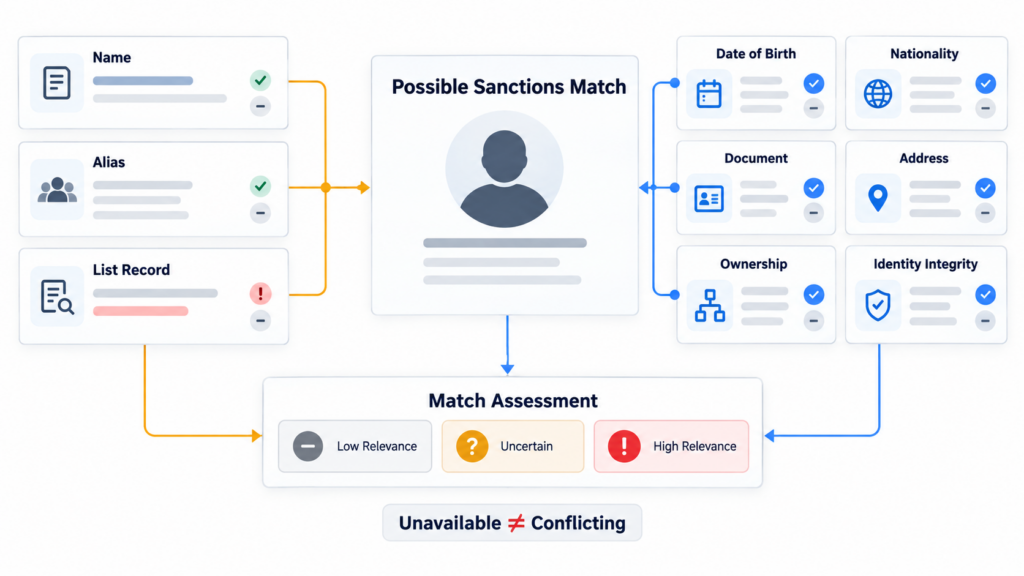
Names should start the screening process, not finish it. A possible match can be compared with other available attributes, including:
- Full and alternative names
- Date of birth or year of birth
- Nationality and residence
- Document information
- Address and geographic associations
- Entity registration details
- Beneficial ownership
- Sanctions program and list source
The workflow should distinguish among three situations:
Consistent data: Multiple verified attributes align with the listed party, increasing match relevance.
Conflicting data: Reliable attributes materially contradict the list record, supporting possible false-positive resolution.
Unavailable data: A comparison cannot be completed because the list or customer record lacks the attribute. Missing information should not be treated as a confirmed mismatch.
Each decision should preserve the matched terms, compared attributes, data source, list version, score, rule results, and reason for resolution or escalation.
4. Use Decision Bands Instead of One Threshold
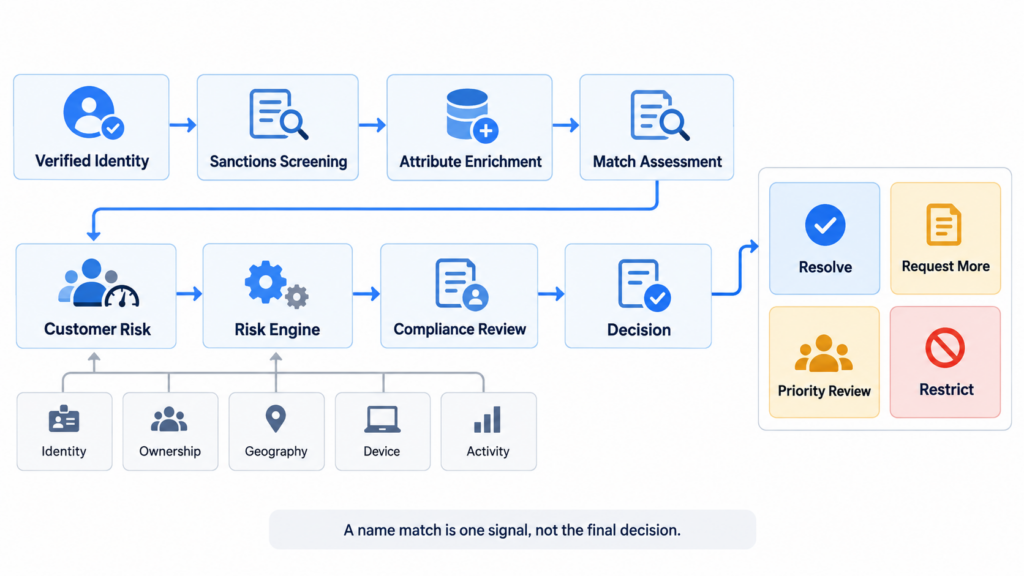
A single name-score threshold is rarely sufficient. A scalable workflow can classify alerts into decision bands:
- Low relevance: Weak name similarity or reliable contradictory attributes. Resolve automatically where policy permits.
- Uncertain: Plausible name match but insufficient supporting information. Request additional evidence or send to standard review.
- High relevance: Strong name and attribute alignment. Route to priority compliance review.
- Critical: Strong sanctions evidence combined with identity manipulation, ownership, geographic, or transaction risk. Apply restrictions required by policy and applicable law.
Thresholds should be calibrated using the organization’s customer base, products, markets, regulatory obligations, and tolerance for false positives and false negatives. OFAC states that users must determine match thresholds according to their internal risk assessments and established compliance practices.
FinAuth’s Risk Engine can combine external screening results with document, biometric, device, behavioral, and onboarding-context signals. A name similarity score therefore becomes one input to the decision—not the decision itself.
5. Keep Human Review for Material Decisions
Automation should reduce repetitive work while preserving human oversight for ambiguous or consequential cases.
Reviewers need a consolidated case view containing:
- The sanctions record and relevant program
- Matched names and aliases
- Verified customer attributes
- Supporting and conflicting evidence
- Identity and device risk signals
- Previous screening decisions
- A complete decision audit trail
Clear review queues can prioritize cases by combined risk instead of processing alerts only by submission time. Confirmed false positives may be reused cautiously, provided the underlying customer data and sanctions record have not materially changed.
Automated screening should not independently make legal conclusions outside approved policy. Institutions remain responsible for determining applicable obligations and whether an account must be rejected, blocked, frozen, reported, or otherwise restricted.
6. Rescreen Customers After Onboarding
Sanctions risk is not static. Lists change, customers update their identity information, entity ownership changes, and new counterparties appear.
Rescreening can be triggered by:
- Sanctions-list additions or amendments
- Customer profile changes
- Changes in beneficial ownership or control
- New beneficiaries and counterparties
- High-risk transactions
- Account recovery or identity reverification
- Periodic review schedules
OFAC notes that screening frequency should reflect internal policy and the organization’s risk profile rather than follow one universal schedule.
FinAuth can use event-level risk to determine whether the customer should be rescreened, reverified, asked for additional evidence, or routed to enhanced review.
7. Measure Automation Quality
Teams should monitor screening effectiveness and operational efficiency together:
- Alerts per application
- Automated resolution rate
- True-match and false-positive rates
- Cases reopened after list updates
- Average review and decision time
- Requests for additional information
- Match performance across languages and scripts
- Confirmed risk missed by automated rules
- Reviewer overrides and their reasons
These metrics help identify overly broad thresholds, weak identity data, inconsistent reviewer decisions, and market-specific matching problems.
8. Sanctions Screening Q&A
Is a sanctions screening match proof that the customer is sanctioned?
No. It is a possible match requiring assessment against verified identity attributes, aliases, list details, and other relevant evidence.
Can sanctions alerts be resolved automatically?
Lower-relevance alerts may be resolved automatically when reliable evidence and approved policy support that outcome. Ambiguous or strong matches should receive appropriate human review.
How can businesses reduce sanctions screening false positives?
Use verified identity data, normalize names, support aliases and transliteration, compare additional attributes, distinguish missing data from conflicting data, and calibrate thresholds using production outcomes.
How does FinAuth support automated sanctions screening?
FinAuth verifies identity data and combines external screening outcomes with document authenticity, face and liveness, device, session, behavioral, and contextual risk. Its Risk Engine helps route cases to automated resolution, additional evidence, priority review, or restriction.
9. Conclusion
Automating sanctions screening requires reliable identity evidence, intelligent matching, attribute-based resolution, current list data, and risk-based escalation. A name match alone is neither sufficient proof nor a complete compliance decision.
By strengthening customer identity and combining screening results with broader risk signals, FinAuth helps organizations reduce unnecessary review work while prioritizing cases supported by credible sanctions evidence.