Customer due diligence should not end when an account is opened. A customer initially classified as low risk may later change devices, ownership structures, transaction behavior, or geographic exposure. When those changes increase financial crime or identity fraud risk, enhanced due diligence (EDD) may be required.
The challenge is deciding when to trigger EDD. If every anomaly creates a manual investigation, compliance teams become overloaded and legitimate customers face unnecessary friction. If escalation rules are too weak, genuinely high-risk activity may remain undetected.
A smarter EDD workflow continuously evaluates customer, identity, device, behavioral, and transactional signals, then applies proportionate controls based on the combined risk.
1. What Is an EDD Risk Trigger?
An EDD risk trigger is an event or combination of signals indicating that standard customer due diligence may no longer provide sufficient assurance.
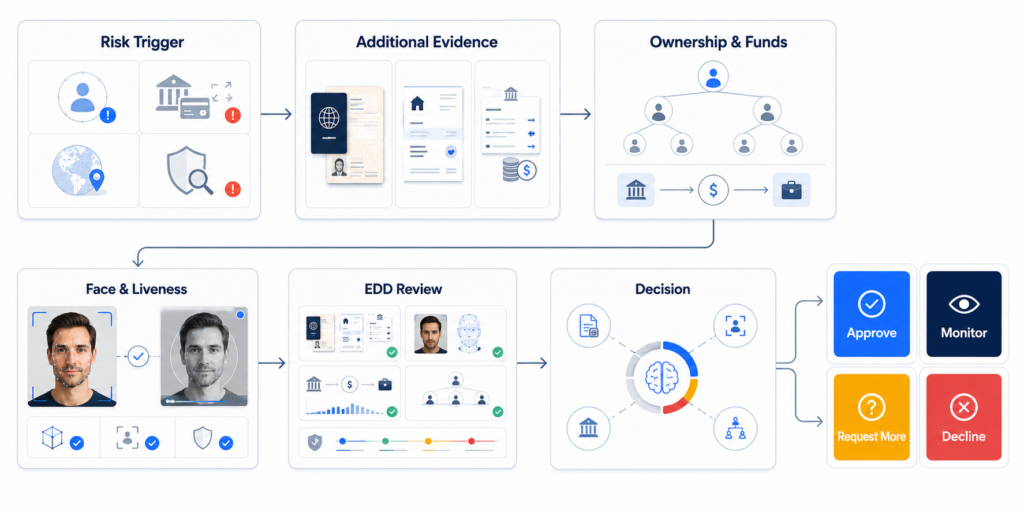
A trigger should not automatically mean that the customer is fraudulent. Instead, it should initiate a deeper risk assessment. Depending on the evidence, the business may request additional documents, verify beneficial ownership, confirm the source of funds, repeat face and liveness checks, or send the case for manual review.
This approach supports the risk-based principle promoted by the FATF. Higher-risk relationships require stronger controls, while lower-risk customers should not face unnecessary verification. Importantly, placement on a jurisdiction’s increased-monitoring list does not automatically require blanket EDD; institutions should consider that information within their own risk analysis. FATF guidance
2. Common Risk Triggers for Enhanced Due Diligence
Effective workflows monitor several categories of risk rather than relying on one rule.
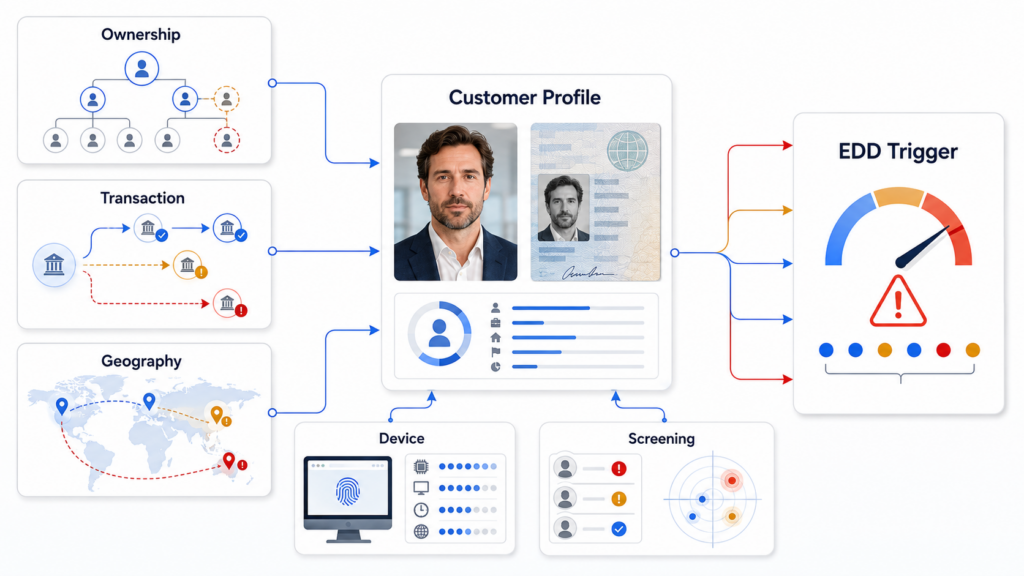
Customer and ownership changes: A new beneficial owner, director, authorized representative, or complex corporate layer may change the original customer risk profile. Inconsistencies between corporate records, submitted documents, and declared ownership should prompt further verification.
Identity anomalies: Expired or replaced identity documents, altered profile information, repeated face-match failures, suspected document manipulation, or failed liveness checks may indicate impersonation or account takeover.
Transaction changes: Sudden increases in transaction value, rapid movement of funds, new high-risk beneficiaries, unusual cash activity, or behavior inconsistent with the customer’s stated purpose may justify stronger due diligence.
Geographic exposure: New activity involving higher-risk jurisdictions, unexpected cross-border transfers, or inconsistencies between declared location, device location, and network data can increase risk. However, geography should be evaluated with other evidence rather than used as an isolated decision rule.
Device and behavioral anomalies: New devices, emulators, virtual environments, injection indicators, abnormal login patterns, or activity that differs significantly from historical behavior may signal that the legitimate customer no longer controls the account.
Screening updates: A new sanctions, politically exposed person, adverse media, or internal watchlist match can require immediate reassessment. Matching quality matters because weak name-only rules may generate excessive false positives.
3. Why Single-Rule EDD Workflows Create Problems
A single rule rarely provides enough context for a reliable EDD decision. A customer using a new device may simply have replaced a laptop. A large transaction may be reasonable for a long-standing business account. A name similarity may be unrelated to the person on a watchlist.
The risk becomes more meaningful when signals overlap. For example, a new device combined with an unusual location, changed beneficiary, face mismatch, and rapid withdrawal creates a stronger case for escalation than any signal alone.
FinAuth helps organizations combine document, face, liveness, device, session, behavioral, and business-context evidence within a configurable Risk Engine. Instead of treating every alert equally, the platform produces an explainable risk outcome and routes the session to the appropriate verification action.
4. Building a Risk-Based EDD Workflow
A scalable workflow should follow four stages.
First, collect relevant signals. Connect onboarding data, ongoing KYC records, transaction monitoring, screening results, device intelligence, and identity verification events. Signals should remain attributable so reviewers can understand why a case was escalated.
Second, evaluate the complete context. The Risk Engine should consider signal severity, frequency, recency, and correlation. Several weak signals may collectively represent a significant risk, while one isolated anomaly may only justify monitoring.
Third, apply proportionate actions. Low-risk cases can continue automatically. Medium-risk cases may require a fresh face and liveness check. Higher-risk cases may require updated identity documents, proof of address, ownership evidence, or source-of-funds documentation. Critical cases can be prioritized for review, restricted, or declined according to policy.
Fourth, maintain an audit trail. Record the triggering signals, evidence collected, verification results, policy version, reviewer actions, and final decision. This makes the EDD process easier to explain during internal reviews and regulatory audits.
FinAuth supports this workflow through document OCR and authenticity analysis, 1:1 face verification, Edge and Cloud liveness detection, injection attack detection, device and session intelligence, and configurable decision orchestration. Businesses can use these capabilities to build stronger EDD controls without forcing every customer through the same high-friction process.
5. How to Reduce Friction Without Weakening EDD
EDD does not need to restart the entire onboarding process. The verification step should match the unresolved risk.
If the risk concerns account control, Face Verification and Liveness Detection may provide sufficient assurance. If document information has changed, document recapture and authenticity checks may be more appropriate. If corporate ownership is unclear, the workflow should request ownership records rather than unrelated personal documents.
FinAuth enables organizations to configure these step-up paths around their own customer segments, products, jurisdictions, and risk appetite. Trusted customers can continue with minimal interruption, while suspicious sessions receive stronger identity verification and prioritized review.
6. EDD Workflow Q&A
What events should trigger enhanced due diligence?
Typical EDD risk triggers include ownership changes, unusual transactions, identity inconsistencies, screening updates, high-risk geographic exposure, suspicious devices, and abnormal account behavior. The final trigger should normally depend on combined risk rather than one isolated signal.
Can EDD be automated?
Yes. FinAuth can automate evidence collection, identity verification, liveness detection, device analysis, risk scoring, and case routing. Human investigators can then focus on cases that require judgment instead of reviewing every alert.
Is face verification enough for EDD?
No. Face Verification establishes whether the user matches a trusted reference, while Liveness Detection helps confirm genuine presence. Strong EDD also considers documents, ownership, transactions, device risk, screening results, and customer context.
How often should EDD be repeated?
EDD should be event-driven as well as periodic. A new high-risk event may justify immediate reassessment even when the scheduled customer review date has not arrived.
7. Conclusion
Smarter EDD begins with better trigger design. Organizations should detect meaningful changes, combine multiple sources of evidence, and apply verification strength in proportion to risk.
By integrating identity verification, document authenticity, face and liveness checks, device intelligence, and configurable risk decisioning, FinAuth helps compliance teams prioritize genuine threats while keeping trusted customer journeys efficient.