A transaction monitoring rule should tell an investigator more than “the amount exceeded a threshold.” It should explain what changed, why the change matters for this customer or product, and what evidence would help resolve it.
For digital banks, lenders, wallets, and payment platforms, the practical approach is to start with a specific risk scenario, turn it into a testable rule, and define how alerts will be investigated before the rule goes live. Transaction data shows how money moved; verified identity, device, and session data can help explain the circumstances.
1. Start With a Risk Scenario, Not a Threshold
Begin by identifying the behavior the rule should detect and where it could occur. A wallet, a merchant settlement account, and a remittance service have different patterns of legitimate activity. Applying the same rule across all three can create unnecessary alerts in one product while missing meaningful activity in another.
For example, a rule designed to identify unusual movement of funds might examine whether incoming funds are followed by outgoing transfers that are inconsistent with the account’s expected use. The same sequence may be routine for a merchant that settles daily but worth reviewing for a personal account with no similar history.
U.S. FFIEC examination guidance likewise ties monitoring criteria to the institution’s risk profile, including its products, customers, and geographies.
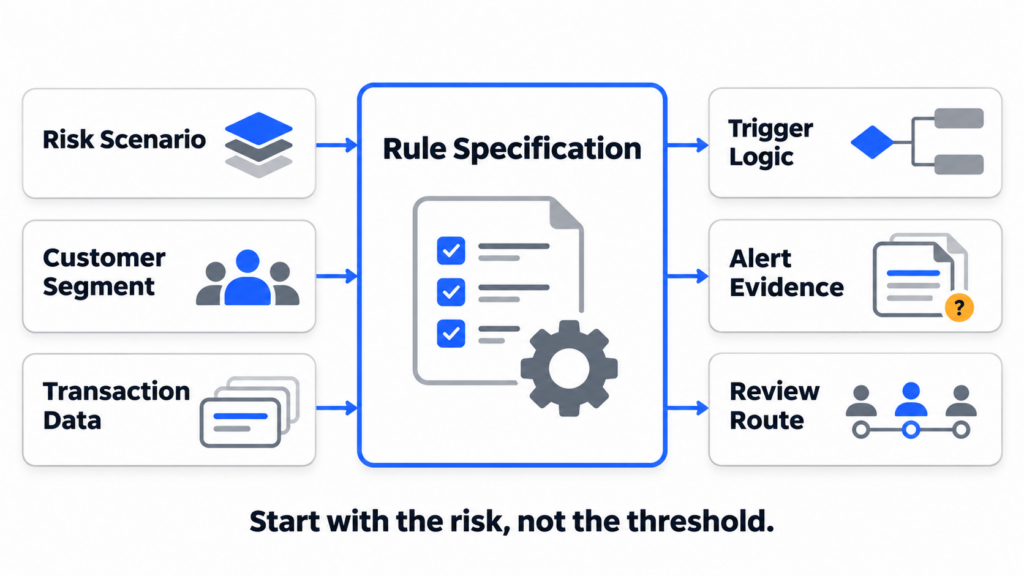
2. Turn the Scenario Into a Rule Specification
Write the specification before implementing the logic. An analyst should be able to reproduce why an alert fired, and an engineer should know what to do when data is missing or delayed.
| Rule component | What to define |
|---|---|
| Scope | Products, customer segments, transaction types, and channels covered |
| Trigger | The pattern being evaluated, including the observation window and whether activity is grouped by account, customer, or counterparty |
| Data handling | Which transaction statuses count, how reversals and duplicate events are handled, and what happens when data is missing |
| Alert evidence | The triggering transactions, relevant customer context, reason code, and rule version |
| Response | Who reviews the alert, how it is prioritized, and when it should be escalated |
Distinguish “no relevant activity” from “data unavailable.” If a payment feed is delayed, a rule should not quietly interpret the missing events as low risk. Track feed coverage and freshness alongside alert volumes so teams can distinguish a genuine decline in unusual activity from a monitoring gap.
3. Calibrate Thresholds Against Expected Activity
Use both the customer’s history and an appropriate peer group where reliable data is available. A customer’s history helps explain seasonal changes or established payment patterns. A peer comparison helps when the account is new or when its own history is not a reliable indicator of legitimate behavior.
Backtest candidate thresholds against representative historical data. Include known cases, ordinary high-volume periods, and a sample of activity that existing rules did not flag. Check results by product and segment rather than relying on a portfolio-wide average.
Evaluate what each candidate adds to existing coverage. If two rules repeatedly flag the same activity, grouping their alerts into one case can reduce duplicate work while preserving both reasons. If a rule surfaces a distinct risk that no other rule captures, keep that coverage visible even if the alert volume is low.
4. Enrich Alerts Before Choosing a Response
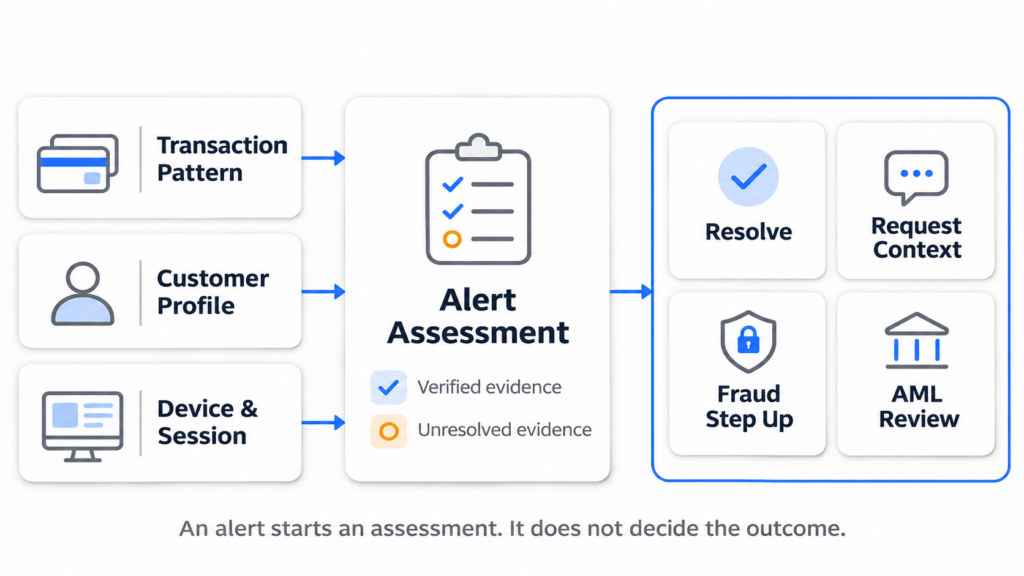
A transaction alert identifies activity that warrants assessment. It does not establish fraud, determine whether a report should be filed, or automatically justify blocking a payment.
FinAuth can add verified identity, device, session, and behavioral signals to an existing monitoring workflow. For example, a transfer that departs from a customer’s normal activity may warrant a different response if it follows account recovery and comes from an unfamiliar session. That combination can inform a fraud-oriented step-up check, such as face verification and liveness. It does not resolve separate AML questions about the purpose or source of the funds.
Where AML concerns remain, route the case to the relevant compliance team with the triggering transactions and supporting evidence. Keep the fraud-control decision and any suspicious activity reporting decision distinct. The FFIEC manual describes alert management, investigation, and reporting decisions as related but separate parts of the monitoring process.
5. Validate Before Launch and Monitor Afterward
Run new rules in shadow mode where feasible: generate alerts without changing live decisions, then compare volume, evidence quality, and coverage with the current setup. Test boundary conditions and operational failures, including late events, reversals, missing identifiers, and overlapping alerts.
After launch, monitor alert volume, duplicate rates, escalation outcomes, queue age, and data completeness by rule and segment. A low escalation rate is a reason to investigate, not automatically a reason to raise the threshold. The issue could be weak evidence, a poorly defined customer segment, or a scenario already covered by another rule.
Document each material change: what changed, why it changed, which segments are affected, who approved it, and how it can be rolled back. Periodic testing and independent review can help assess whether the implemented logic still detects the activity it was designed to surface.
6. Transaction Monitoring Rules: Q&A
Should transaction monitoring run in real time?
Use real-time evaluation when a decision must be made before an action proceeds. Scheduled monitoring can be useful for patterns that emerge over longer periods. Define the required response time for each scenario before choosing the processing model.
How can teams reduce false positives without weakening coverage?
Start by fixing data quality, refining customer segments, and grouping duplicate alerts. Test any threshold change against known cases and a sample of unflagged activity before deploying it.
Can behavioral analytics replace rules?
Not necessarily. Rules make known scenarios explicit and auditable. Behavioral analytics adds context when activity departs from a customer baseline or peer pattern. Both can contribute evidence to the same investigation.
7. Conclusion
Before deploying a rule, make sure your team can answer three questions: What risk does this rule cover? Why did it flag this activity? What should the reviewer do next? Build around those answers, then use identity, device, and session evidence from FinAuth to give investigators more context without treating any single signal as the final decision.