Account security has traditionally relied on fixed controls: enter a password, provide a one-time code, or complete the same authentication steps every time. This approach is predictable, but it creates two problems. Low-risk users face unnecessary friction, while sophisticated account takeover attempts may still pass through controls designed around a limited set of credentials.
Risk-based authentication, or RBA, takes a more adaptive approach. It evaluates the context of each session and selects an authentication action that matches the detected risk. Trusted activity can continue with minimal interruption, while unusual or high-risk activity triggers stronger identity verification.
FinAuth supports this model by combining device intelligence, session context, behavioral signals, facial verification, liveness detection, and policy-based decisioning within one account security workflow.
1. Why Fixed Authentication Is No Longer Enough
Passwords, SMS codes, and security questions verify whether a user possesses specific information or controls a registered communication channel. They do not always confirm that the person initiating an action is the legitimate account owner.
Attackers can acquire credentials through phishing, malware, data breaches, social engineering, SIM swapping, or credential stuffing. Once the initial login barrier is passed, a fixed authentication process may treat the attacker like a genuine user.
Applying maximum security to every session is not an effective alternative. Requiring facial verification for every login, for example, can increase abandonment, authentication fatigue, and support costs.
RBA addresses this conflict by continuously answering two questions:
- How risky is the current session or action?
- What level of verification is proportionate to that risk?
2. How Risk-Based Authentication Works
An RBA workflow starts by collecting signals before and during an account interaction. These signals are evaluated by a risk engine, which produces a risk level and determines the next action.
A familiar device accessing an account from a usual location may be classified as low risk. A login involving a new device, unusual network, abnormal behavior, and an immediate withdrawal request may be classified as high risk.
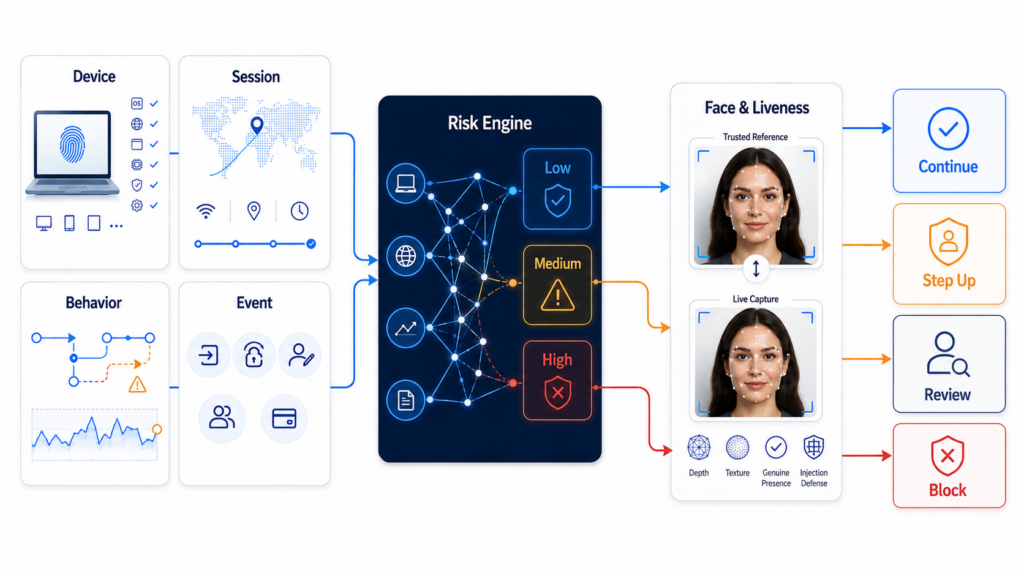
FinAuth enables organizations to configure different actions for different risk levels:
- Low risk: allow the user to continue.
- Medium risk: request an additional credential or face check.
- High risk: trigger face verification with liveness detection.
- Critical risk: send the session for review or block the action.
This creates a dynamic security layer around account login, account recovery, profile changes, new-recipient registration, and high-value transactions.
3. Which Signals Should an RBA System Evaluate?
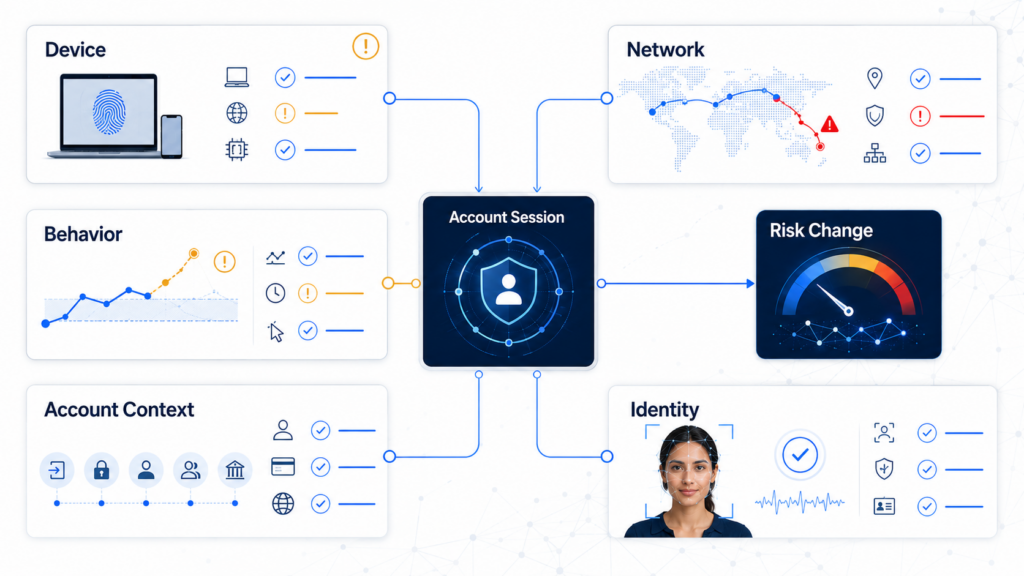
Effective account security depends on multiple signals rather than a single indicator.
Device intelligence can identify unfamiliar devices, emulators, automation environments, suspicious configurations, and changes in the device fingerprint.
Network and location signals can reveal proxy usage, unusual IP reputation, impossible travel patterns, or unexpected geographic changes.
Behavioral signals compare current activity with historical patterns, including navigation paths, interaction speed, login frequency, and transaction behavior.
Account context considers the sensitivity of the requested action. Viewing a balance is not equivalent to changing a recovery method or transferring funds to a new recipient.
Identity signals provide stronger assurance when contextual risk is elevated. FinAuth can compare a fresh face capture with a trusted reference image and use Edge and Cloud liveness detection to evaluate genuine presence and defend against photo, replay, deepfake, and injection attacks.
A shared device or location alone may have a legitimate explanation. Risk becomes more meaningful when several abnormal signals overlap.
4. Matching Authentication to the Level of Risk
The main benefit of RBA is proportionality. Instead of dividing every session into a simple allow-or-deny result, organizations can create graduated responses.
A low-risk customer can access routine functions without additional friction. A medium-risk session may require an OTP, trusted-device confirmation, or another lightweight challenge. High-risk activity can trigger FinAuth Face Verification and Liveness Detection. Suspicious sessions involving failed biometrics, injection indicators, or coordinated fraud signals can be reviewed or blocked.
The policy should also reflect the value and reversibility of the action. A failed attempt to view non-sensitive information may justify a retry, while an abnormal account recovery or large withdrawal may require stronger identity assurance.
This approach concentrates verification costs and customer effort on the sessions that need them most.
5. Building RBA with FinAuth
FinAuth provides the identity and fraud decisioning capabilities needed to connect contextual risk with stronger authentication.
Its Device and Session Risk capabilities help identify changes in the environment used to access an account. Behavioral and event data can be combined with account-specific rules inside the Risk Engine. When step-up verification is required, Face Verification checks whether the fresh capture matches the trusted account holder, while Liveness Detection evaluates whether the capture represents a real person present during the session.
The Risk Engine combines these results instead of allowing one signal to determine the outcome. For example, a new device does not automatically mean fraud, and a successful face match does not automatically prove that the capture is live. The final decision should reflect device, session, behavior, biometric confidence, liveness, and transaction context together.
FinAuth can support configurable flows through SDK and API integration, allowing businesses to apply different policies across login, recovery, sensitive account changes, and transactions.
6. How to Protect Users Without Creating Excessive Friction
A successful RBA strategy should measure both fraud prevention and customer experience.
Organizations should monitor step-up rates, verification completion, false rejections, retry frequency, review volume, and confirmed fraud outcomes. If too many genuine users are challenged, policies may be overly sensitive. If high-risk actions frequently pass without stronger checks, thresholds may be too permissive.
Clear fallback paths are equally important. Customers should be able to retry a poor-quality capture, use an approved alternative, or enter manual review when automated verification remains uncertain.
Risk policies should also be updated as attacker behavior changes. Account takeover methods, deepfake tools, device manipulation techniques, and injection attacks evolve continuously. Performance monitoring and fraud feedback should therefore feed back into FinAuth policy and model updates.
7. Frequently Asked Questions
Q1. What is risk-based authentication?
Risk-based authentication is an adaptive account security method that evaluates device, network, behavior, identity, and event context before selecting an authentication action. It allows trusted users to continue smoothly while applying step-up verification to elevated-risk sessions.
Q2. Is risk-based authentication the same as multi-factor authentication?
No. Multi-factor authentication requires multiple authentication factors. RBA determines when additional factors are necessary and which challenge is appropriate. The two approaches can work together.
Q3. How does FinAuth support account takeover prevention?
FinAuth combines device and session intelligence, behavioral risk, face verification, liveness detection, and a configurable Risk Engine. These capabilities help businesses identify suspicious account activity and trigger proportionate actions such as continuing, stepping up, reviewing, or blocking.
Q4. Should every high-risk session require facial verification?
Not necessarily. The appropriate action depends on the risk level, requested operation, available reference identity, regulatory requirements, and recovery options. Facial verification is particularly valuable for account recovery, sensitive profile changes, and high-risk transactions where stronger identity assurance is needed.
8. From Static Barriers to Adaptive Account Security
Risk-based authentication improves account security by making verification responsive to real session conditions. It reduces unnecessary friction for trusted customers while giving organizations stronger controls when device, behavior, identity, or transaction signals indicate elevated risk.
By integrating contextual intelligence with face verification, liveness detection, and multi-signal decisioning, FinAuth helps digital businesses build authentication flows that protect accounts without treating every customer interaction as equally suspicious.