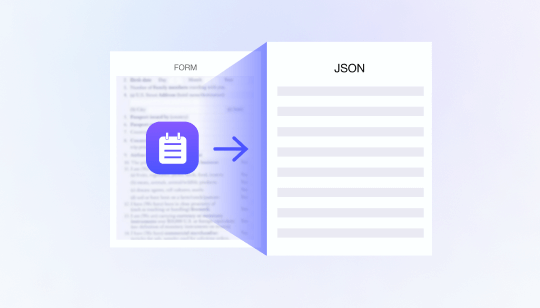
Expanding digital onboarding into multiple countries creates more than a document coverage problem. Identity documents vary by language, layout, security features, issuing authority, data format, and version. A workflow that performs well for one passport or national ID may fail when it encounters a regional document, an older version, or a different capture environment.
A scalable global workflow must recognize local differences while maintaining one consistent decision architecture. FinAuth addresses this challenge by combining document classification, OCR, authenticity analysis, face verification, liveness detection, device intelligence, and configurable risk decisioning within a unified eKYC platform.
1. Why Multi-Country Document Verification Is Complex
Global document verification cannot be built around a single template. Even documents serving the same purpose may organize identity fields differently.
Common variations include:
- Printed, handwritten, or machine-readable fields
- Latin and non-Latin scripts
- Different date, name, and address formats
- Front-only and front-and-back documents
- Multiple versions of the same document type
- Physical and digital identity credentials
- Country-specific security patterns
- Different expiry and validity rules
Operational conditions add another layer of complexity. Users may submit documents under poor lighting, with glare, blur, cropping, perspective distortion, or low camera resolution.
A scalable system must distinguish between an unsupported document, a poor-quality capture, an extraction problem, and a genuine fraud indicator. Treating every failure as fraud creates unnecessary rejection and manual review.
2. Start with Document Classification and Quality Control
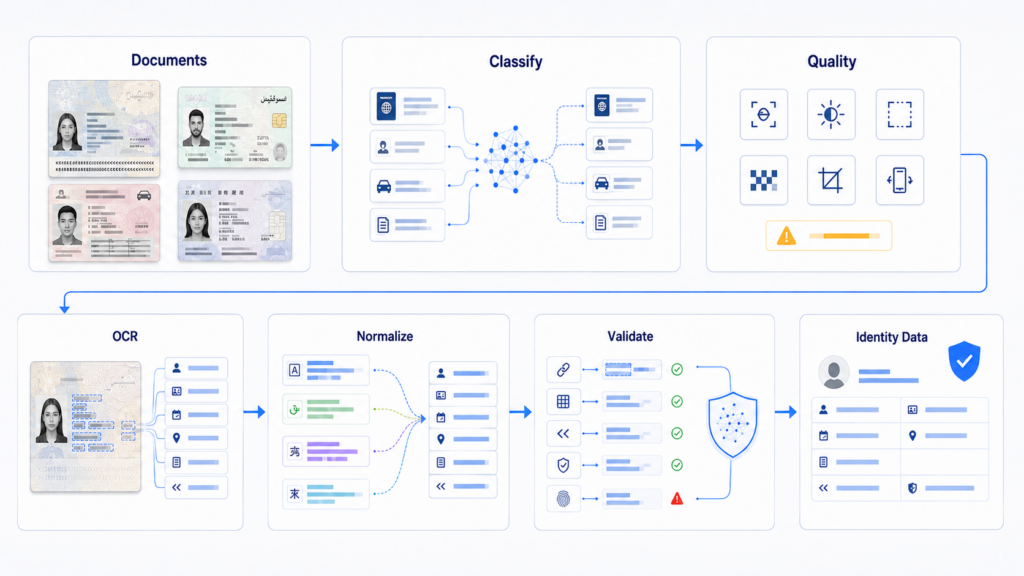
The first step is to determine what document has been submitted. This includes identifying the issuing country, document category, version, side, and expected structure.
FinAuth can use visual document understanding to route the image to the appropriate processing logic. Early classification prevents the workflow from applying the wrong field map or authenticity model.
Before OCR begins, the system should also evaluate capture quality. Blur, glare, missing edges, excessive rotation, low resolution, and obstruction can reduce extraction accuracy and hide manipulation indicators.
When quality is insufficient, the correct action is usually recapture—not rejection. FinAuth can return actionable quality feedback so the user can correct the image before the verification process continues.
This early control reduces unnecessary processing and prevents low-quality inputs from creating misleading risk signals later in the workflow.
3. Normalize Local Documents into Global Identity Data
After classification and quality control, OCR extracts relevant fields such as:
- Full name
- Date of birth
- Document number
- Nationality
- Issuing authority
- Issue and expiry dates
- Address
- Machine-readable zone data
The challenge is not simply reading the text. The extracted information must be normalized into a consistent data structure that downstream systems can use.
For example, names may follow different orders, dates may use different formats, and addresses may contain administrative divisions unfamiliar to the onboarding platform. Some documents provide the same field in multiple languages, while others use localized calendars or abbreviations.
FinAuth converts document-specific fields into standardized outputs while preserving the original values for audit and review. This allows one onboarding platform to process different document formats without requiring separate business logic for every market.
Cross-field validation can then compare OCR results with machine-readable zones, barcodes, front-and-back information, and user-entered data.
4. Separate Readability from Document Authenticity
A document can be easy to read and still be fraudulent. OCR only determines what information appears in the image; it does not establish whether the document is genuine.
FinAuth Document Verification evaluates broader visual and structural evidence, including:
- Expected document layout and field placement
- Portrait and text-region consistency
- Security textures and background patterns
- Signs of digital editing or replacement
- Image splicing and software composition
- Recaptured documents and screen displays
- Screenshots or manipulated digital files
- Consistency between the front and back
This distinction is critical for international verification. Fraudsters may start with a genuine document image and replace only the portrait, name, or date of birth. The resulting document may remain fully readable while containing manipulated identity information.
FinAuth uses Large Visual Model capabilities to interpret the document as a complete visual object rather than treating it as isolated text fields.
5. Connect the Document to the Person Presenting It
Document authenticity does not prove that the applicant is the legitimate holder.
For higher-assurance onboarding, FinAuth Face Verification compares the document portrait with a fresh facial capture. Liveness Detection evaluates whether a real person is present during the session and helps defend against printed photos, video replays, masks, deepfakes, virtual cameras, and manipulated media injection.
These results should be evaluated together. A strong face match with failed liveness may indicate that an attacker has obtained media of the genuine document owner. A live user with a weak face match may be using another person’s document.
Combining document evidence with face and liveness signals creates stronger identity assurance than any individual check.
6. Use Risk-Based Decisioning Across Markets
Global operations require consistent controls, but not every market or user should follow an identical journey.
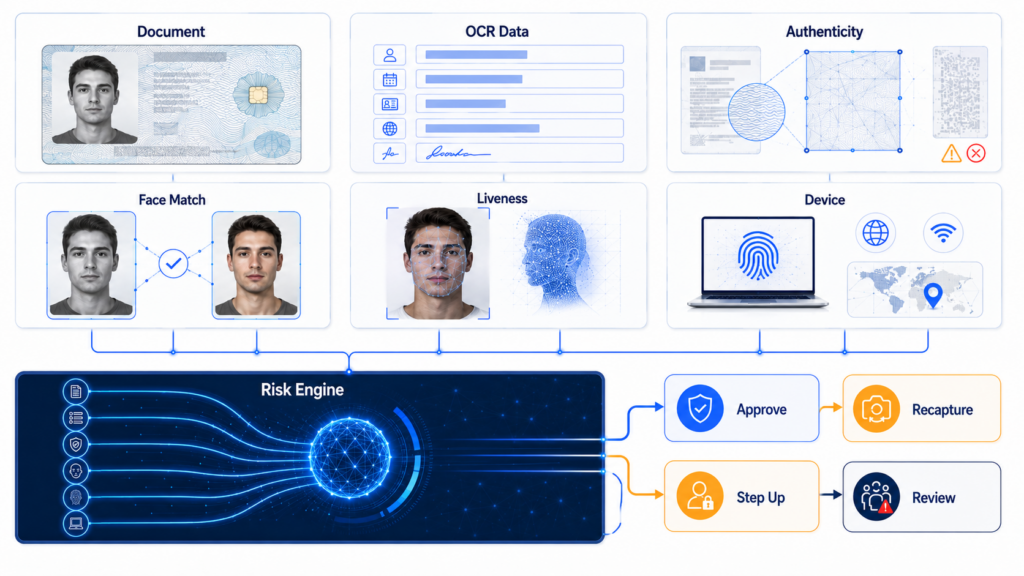
FinAuth Risk Engine can combine:
- Document classification and quality
- OCR confidence and field consistency
- Authenticity results
- Face-match confidence
- Liveness and injection-detection results
- Device and session risk
- Behavioral signals
- Country and business context
Low-risk applications with consistent evidence can be approved automatically. Poor-quality images can trigger recapture. Uncertain identity evidence can require additional verification, while suspicious documents or biometric attacks can be routed to review or rejection.
Organizations can maintain a common decision framework while configuring thresholds, required documents, verification steps, and fallback options for each country or product.
7. Build for Document Versions and Operational Change
Document coverage is not a one-time integration task. Governments introduce new document versions, update security features, retire older formats, and expand digital credential programs.
A scalable workflow therefore needs ongoing document-library maintenance, model updates, performance monitoring, and feedback from confirmed fraud and manual review.
FinAuth provides SDK and REST API integration options that allow businesses to add markets without rebuilding the entire verification journey. Private, hybrid, and edge deployment options can also support different operational, latency, and data-governance requirements.
Teams should monitor extraction success, recapture rates, document-type distribution, false rejections, review volume, and confirmed fraud by country and document version. Global averages can hide local performance gaps.
8. Frequently Asked Questions
Q1. What is multi-country document verification?
It is the ability to capture, classify, read, authenticate, and evaluate identity documents from multiple countries through a consistent digital workflow.
Q2. Is document OCR enough for international eKYC?
No. OCR extracts information, but it does not independently prove that the document is genuine. FinAuth combines OCR with document authenticity analysis, consistency checks, and risk decisioning.
Q3. Why should document type be identified before OCR?
Classification determines which fields, layouts, formats, and security characteristics the system should expect. Incorrect classification can reduce extraction accuracy and create unreliable verification results.
Q4. Does every country need a completely separate workflow?
Not necessarily. Businesses can use a common FinAuth verification architecture while configuring document rules, thresholds, and fallback options for individual markets.
Q5. How can businesses reduce manual review across countries?
They can improve capture guidance, classify documents early, normalize extracted data, combine multiple verification signals, and send only genuinely uncertain cases to review.
9. One Architecture, Local Verification Intelligence
Scalable global document verification requires both standardization and localization. The decision architecture should remain consistent, while document recognition, field extraction, authenticity analysis, and policy controls adapt to local formats.
By combining LVM-powered Document Verification with Face Verification, Liveness Detection, device intelligence, and a configurable Risk Engine, FinAuth helps businesses expand digital onboarding across markets without building a separate verification stack for every country.