Liveness Detection is essential for remote identity verification, but it is not a universal deepfake defense. Its effectiveness depends on where an attack enters the verification process and which signals the system can observe.
A printed photo shown to a camera, a replayed video, a real-time face swap, and a synthetic video injected directly into an application are different attack classes. Each requires different controls. Businesses therefore need to combine Liveness Detection with injection detection, deepfake analysis, Face Verification, device intelligence, and risk-based decisioning.
1. What Does Liveness Detection Verify?
Liveness Detection evaluates whether biometric evidence appears to come from a live person participating in the session rather than from a presentation artifact.
Two common approaches are:
Passive liveness: Analyzes the capture without requiring a specific user action. It may inspect facial texture, depth cues, motion, reflections, image consistency, and other signals.
Active liveness: Asks the user to perform an action, such as turning their head or following an on-screen instruction. The system checks whether the response is timely and consistent with the challenge.
These controls primarily address attacks presented to the camera, including:
- Printed photographs
- Photos displayed on another screen
- Replayed videos
- Paper cutouts
- Some 2D or 3D masks
- Basic pre-recorded deepfake replays
NIST describes presentation attacks as attempts to interfere with biometric capture by presenting an artifact or altered biometric characteristic to the sensor.
2. Why Deepfake Attacks Are a Broader Problem
A deepfake is synthetic or manipulated media that can imitate a real person’s appearance or behavior. In identity verification, it can be used in several ways:
Presentation-based deepfake: A generated video is played on a screen and shown to the legitimate camera.
Real-time face manipulation: Software changes the attacker’s face during a live session.
Virtual-camera attack: A synthetic video source is supplied to the application as though it were a physical camera.
Direct injection: An attacker bypasses normal capture and inserts manipulated image or video data into the application, SDK, API, or operating-system media pipeline.
Document portrait manipulation: An AI-generated, face-swapped, or morphed portrait is embedded in identity evidence.
NIST warns that emerging attacks combine generative AI with digital injection to target document validation, biometric operations, and visual identity comparisons.
The key distinction is the attack path. If synthetic media never passes through the expected camera, camera-level liveness signals may be incomplete, altered, or entirely bypassed.
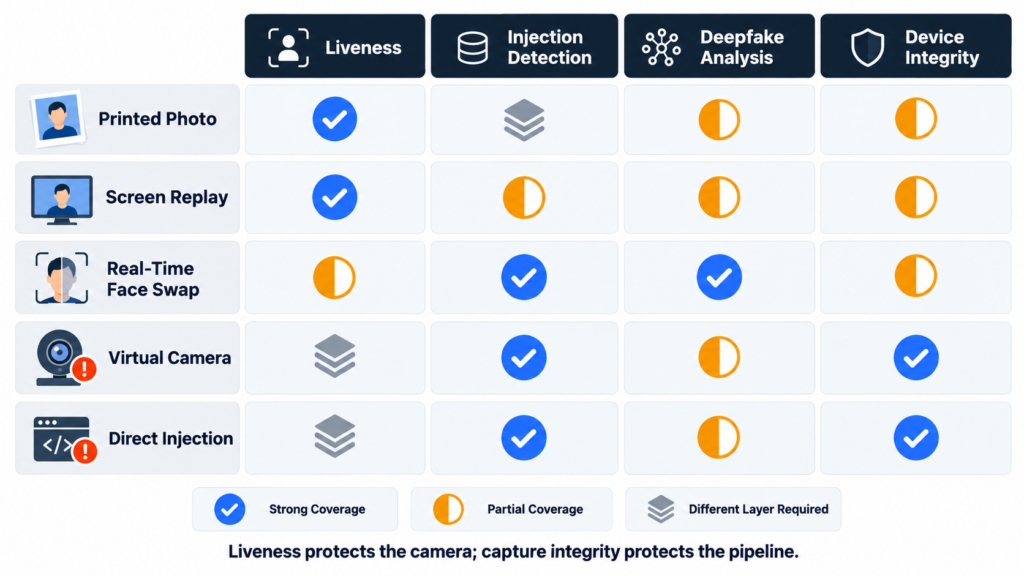
3. What Liveness Detection Can Stop
Well-designed Liveness Detection can identify many attacks that interact with the capture sensor:
- Flat or static presentation media
- Screen glare, moiré, borders, and replay artifacts
- Unnatural motion or depth
- Inconsistent facial responses
- Mask and cutout characteristics
- Some generated or manipulated videos presented through a screen
- Replays that cannot respond correctly to randomized challenges
FinAuth combines Edge and Cloud Liveness Detection. Edge controls can evaluate the capture process and provide immediate feedback, while cloud analysis can apply deeper models to the submitted evidence.
However, performance depends on the attack type, capture environment, camera, compression, and adversarial adaptation. A liveness result should therefore be treated as one security signal rather than absolute proof that the complete session is trustworthy.
4. What Liveness Detection Cannot Reliably Stop Alone
Liveness Detection may not independently detect:
Capture-pipeline bypass: Synthetic frames injected after the camera-level checks may never produce the physical signals that liveness expects to examine.
Advanced real-time manipulation: A deepfake can preserve natural blinking, head movement, expressions, and challenge responses while replacing identity characteristics.
Compromised devices: Rooting, hooking, virtual environments, modified applications, and emulators can interfere with capture or security logic.
Stolen genuine sessions: An attacker may reuse authentic capture material or manipulate a previously valid interaction.
Document-side manipulation: Liveness cannot determine whether a document portrait was replaced, morphed, or synthetically generated.
Post-capture substitution: Genuine frames may be replaced after initial capture if the pipeline lacks integrity protection.
NIST’s identity-proofing threat model explicitly separates presentation attacks from video or image injection attacks, including deepfake video used to impersonate the person shown on stolen identity evidence.
5. Why Deepfake Detection Is Also Not Enough
Deepfake Detection analyzes whether media contains signs of AI generation or manipulation. It may inspect spatial artifacts, temporal inconsistency, facial boundaries, texture, lighting, frequency patterns, or model-specific traces.
This adds valuable protection, but it also has limits:
- New generation methods may not resemble known attacks.
- Resizing, compression, filtering, and screen recapture can hide artifacts.
- Genuine media may be incorrectly flagged under unusual capture conditions.
- A real video can still be stolen and fraudulently replayed.
- Deepfake analysis alone does not prove that the media came from a trusted camera.
- Synthetic-content detectors may degrade as attackers adapt to detection models.
NIST notes that synthetic-content detection may examine content characteristics or provenance information such as metadata and digital watermarks. No single method covers every form of synthetic media or establishes the complete integrity of an identity session.
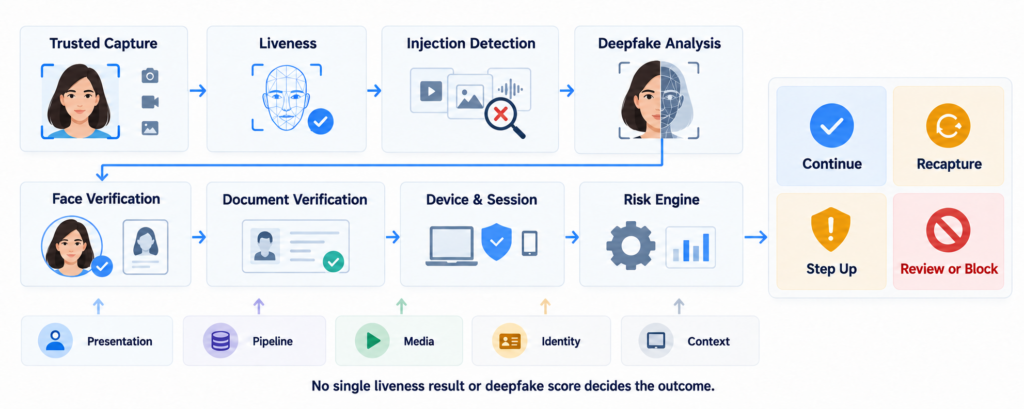
6. Build a Layered Verification Workflow
A stronger defense assigns a specific job to each layer:
- Trusted capture: Protect the camera-to-application path and validate capture origin.
- Presentation Attack Detection: Detect photos, screens, masks, and replay media presented to the sensor.
- Injection detection: Identify virtual cameras, hooks, emulators, modified pipelines, and substituted media.
- Deepfake analysis: Evaluate submitted images or video for synthetic manipulation.
- Face Verification: Determine whether the captured face matches the trusted portrait.
- Document Verification: Detect altered, recaptured, or synthetic identity evidence.
- Device and session intelligence: Assess device integrity, repeated attempts, linked accounts, and abnormal behavior.
- Risk Engine: Combine all results and select a proportionate action.
With FinAuth, a strong face match cannot override injection evidence, and a liveness pass cannot automatically clear a high-risk device. The Risk Engine can route trusted sessions forward, request recapture, apply stronger verification, or prioritize review.
7. Liveness and Deepfake Detection Q&A
Can Liveness Detection detect deepfakes?
It can detect some deepfake attacks, particularly when manipulated media is replayed to the camera or fails liveness challenges. It may not reliably detect synthetic media injected after trusted capture controls.
Is a liveness pass proof that the user is genuine?
No. It indicates that the observed biometric evidence satisfied the liveness controls. Identity matching, capture integrity, document authenticity, and contextual risk must still be evaluated.
What is the difference between replay and injection attacks?
A replay attack presents recorded media to the camera. An injection attack inserts media into the digital capture pipeline, potentially bypassing the camera and its security signals.
How does FinAuth defend against deepfake identity fraud?
FinAuth combines Edge and Cloud Liveness Detection, injection detection, Face Verification, Document Verification, device and session intelligence, behavioral signals, and risk-based decisioning. Each layer addresses a different attack surface.
8. Conclusion
Liveness Detection remains a critical control against presentation attacks, but deepfake fraud extends beyond what the camera can see. Virtual cameras, direct injection, compromised devices, manipulated documents, and adaptive synthetic media require separate defenses.
The strongest architecture does not ask one model to identify every attack. It combines trusted capture, liveness, injection detection, deepfake analysis, identity comparison, document verification, and contextual risk through a unified decision workflow.