Remote identity verification can protect digital onboarding from impersonation, stolen documents, deepfakes, and account abuse. Yet it can also create unnecessary friction when users encounter unclear instructions, repeated capture failures, or verification journeys that do not reflect their actual risk.
The solution is not to remove important controls. Businesses should improve capture quality, distinguish usability problems from fraud signals, and apply proportionate verification through a risk-based workflow. FinAuth helps organizations coordinate document verification, facial comparison, liveness detection, device intelligence, and contextual risk signals so trusted customers can complete verification efficiently without exposing the business to greater identity fraud.
1. Identify Where Verification Drop-Off Happens
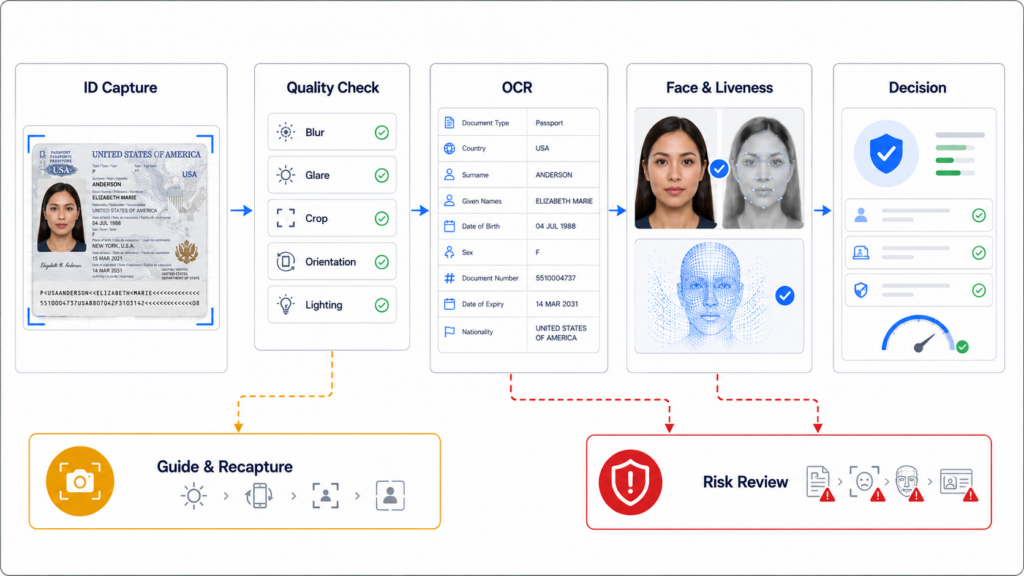
Remote identity verification is not one step. It is a sequence that may include document capture, OCR data extraction, document authenticity analysis, face verification, liveness detection, and risk decisioning.
Drop-off commonly occurs when users:
- Cannot capture a clear identity document.
- Receive generic error messages after blur, glare, or cropping failures.
- Must manually enter information already visible on the document.
- Repeat facial or liveness checks without knowing what went wrong.
- Are asked to restart the entire session after a temporary interruption.
- Wait too long for a decision or manual review.
Businesses should measure completion and abandonment at each stage instead of treating the verification journey as a single conversion event. FinAuth can return structured results for individual checks, making it easier to identify whether friction comes from capture quality, unsupported documents, biometric performance, device conditions, or risk rules.
2. Improve Input Quality Before Relaxing Security Controls
Poor input quality can reduce both security and conversion. A blurred identity document may prevent OCR extraction while also hiding manipulation indicators. A poorly illuminated facial capture can make facial comparison and liveness analysis less reliable.
The verification interface should therefore detect problems such as blur, glare, obstruction, incorrect orientation, missing document edges, and insufficient resolution before submitting the image. Users should receive specific guidance such as “Move the document closer” or “Reduce reflection” instead of a generic failure message.
FinAuth document verification can combine guided capture, document classification, quality analysis, OCR, and authenticity checks. Extracted fields can prefill onboarding forms, reducing manual work while preserving the original evidence for validation.
NIST’s identity-proofing guidance emphasizes validating the authenticity, accuracy, and validity of identity evidence before verifying that the applicant is its genuine owner. It also recognizes automated document validation and facial comparison within remote identity-proofing workflows. NIST Identity Proofing Overview
3. Separate Quality Failures from Fraud Indicators
A failed capture does not automatically indicate fraud. A legitimate customer may have an old device, unstable network, damaged document, or difficult lighting conditions. Conversely, a technically clear image may still contain document manipulation or an injection attack.
FinAuth separates quality signals from security signals so the workflow can respond appropriately:
- A quality problem can trigger guided recapture.
- An uncertain field can request confirmation or additional evidence.
- A suspicious document can require stronger identity verification.
- A possible spoof or injection attempt can trigger enhanced liveness checks or review.
- Repeated failures across multiple signals can increase the session risk score.
This distinction reduces false rejection while preventing attackers from using the recapture process to bypass controls.
4. Apply Risk-Based Verification Instead of One Fixed Journey
Requiring every customer to complete the maximum verification flow creates unnecessary friction. A better approach is to adjust verification strength according to customer, session, and event risk.
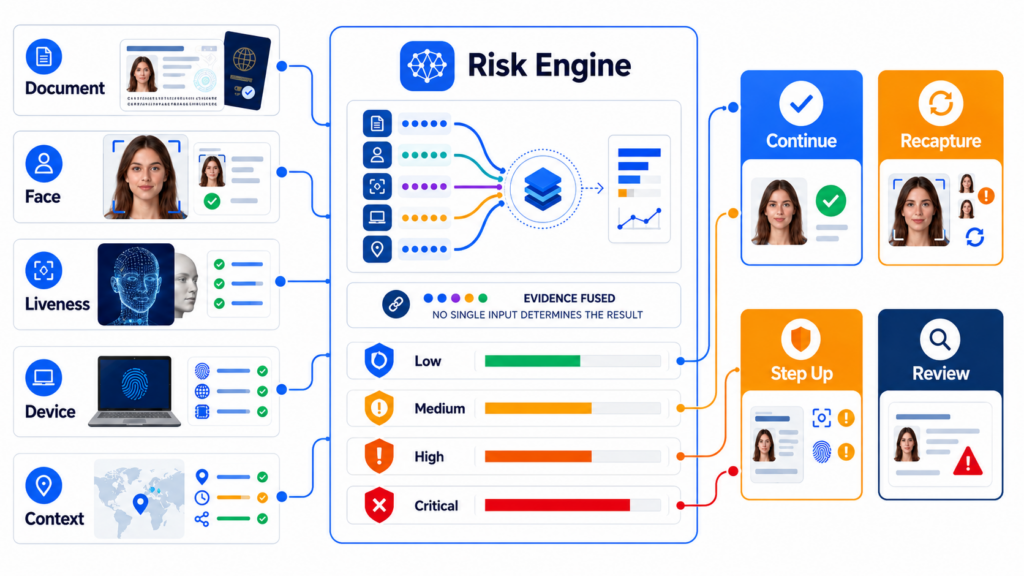
FinAuth can combine document results, facial similarity, liveness confidence, device intelligence, network conditions, behavioral patterns, and onboarding context in a unified Risk Engine. The resulting workflow may route sessions differently:
- Low risk: Continue with a streamlined verification journey.
- Medium risk: Request recapture or an additional identity signal.
- High risk: Require face and liveness verification, stronger document checks, or supplementary evidence.
- Critical risk: Route the session to priority review or reject it.
No individual facial score, device signal, or name mismatch should determine the outcome alone. NIST similarly recommends identity-proofing pathways that respond to different use cases, populations, and threat environments. NIST Identity Proofing Requirements
5. Build Better Recovery Paths
A secure verification flow should help genuine users recover from ordinary errors without making attackers’ work easier.
Effective recovery controls include preserving completed steps, displaying field-level errors, limiting repeated attempts, and changing the verification method when the same check continues to fail. For example, FinAuth can route an unsuccessful document capture to assisted recapture, while a suspicious document combined with device anomalies can move directly to step-up verification.
Businesses should also provide controlled fallback options for users whose documents, devices, or accessibility needs cannot be handled by the default flow. The fallback must deliver comparable identity assurance rather than becoming a weaker path around the primary controls.
6. Measure Conversion and Fraud Outcomes Together
Optimizing only for completion rate can weaken security, while optimizing only for fraud rejection can create excessive false declines. Both sides should be monitored together.
Useful metrics include:
- First-attempt and eventual completion rates.
- Recapture rates by document type and country.
- Average verification and decision time.
- Face and liveness retry frequency.
- Step-up and manual-review volume.
- False rejection and confirmed fraud rates.
- Performance by device, browser, market, and verification pathway.
FinAuth’s structured verification outputs help teams determine which controls stop genuine users, which signals identify real attacks, and where decision thresholds should be recalibrated.
7. Frequently Asked Questions
Q1. Why do users abandon remote identity verification?
The most common causes include poor capture guidance, repeated generic errors, excessive data entry, long processing times, and verification requirements that are disproportionate to the session’s risk.
Q2. Can businesses reduce verification steps safely?
Yes, when steps are selected through risk-based orchestration. FinAuth can allow lower-risk sessions to follow a streamlined path while applying document verification, face verification, liveness detection, or manual review to elevated-risk sessions.
Q3. How does FinAuth reduce identity verification drop-off?
FinAuth improves document capture, automates OCR data extraction, distinguishes quality issues from fraud indicators, and combines biometric, device, and contextual evidence through its Risk Engine. This helps genuine users recover from correctable problems while suspicious sessions receive stronger checks.
Q4. What should happen after repeated verification failures?
The system should examine the complete signal set. Repeated quality failures may require a different capture method, while repeated failures combined with document, device, or liveness anomalies may justify full KYC, manual review, or rejection.
8. Conclusion
Reducing remote identity verification drop-off does not require weaker security. It requires better capture experiences, clearer recovery paths, multi-signal risk assessment, and verification strength that matches the actual level of risk.
By integrating document verification, face matching, liveness detection, device intelligence, and risk-based decisioning, FinAuth enables businesses to protect digital onboarding while giving legitimate customers a faster and more understandable verification journey.