Age verification is becoming essential for digital platforms that offer age-restricted content, financial services, gaming, social features, or regulated products. However, applying the strongest identity check to every user can create unnecessary friction and require more personal data than the situation justifies.
Risk-based age verification offers a more proportionate approach. It evaluates the user, session, requested service, and available evidence before selecting an appropriate verification method. Low-risk users can complete a lightweight check, while higher-risk or uncertain cases move to stronger identity verification.
FinAuth supports this layered model by combining document OCR, document authenticity analysis, face verification, liveness detection, device intelligence, and configurable risk decisioning.
1. Why a Single Age Check Is Not Enough
A checkbox asking users to confirm their age is easy to complete but provides little assurance. At the other extreme, requiring every visitor to upload an identity document may introduce excessive friction, privacy concerns, and abandonment.
The appropriate level of verification depends on the consequences of an incorrect decision. Accessing general content and opening a regulated financial account do not create the same risk. An age verification workflow should therefore consider:
- The legal or policy-based age threshold
- The sensitivity of the product or service
- The value and reversibility of the requested action
- The reliability of existing age evidence
- Device, session, and behavioral anomalies
- Previous failed or inconsistent verification attempts
Risk-based age verification moves the question from “Did the user pass one check?” to “Is the available evidence strong enough for this specific interaction?”
2. Building a Tiered Age Verification Model
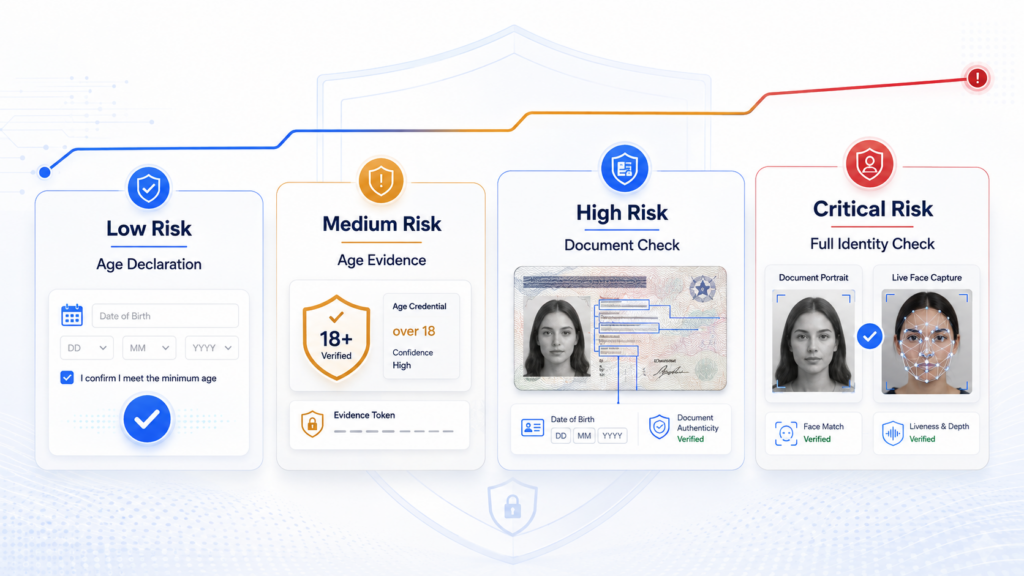
A practical model can divide users into several assurance levels.
Low risk: A lightweight age declaration or trusted account attribute may be sufficient when the service has limited exposure and no abnormal signals are present.
Medium risk: The platform can request additional evidence, such as an approved age credential, document-based date-of-birth extraction, or another step-up method.
High risk: Strong identity evidence may be required when a user attempts to access a regulated service, creates inconsistent age claims, changes account details, or presents suspicious device and session signals.
Critical risk: The platform may request full identity verification, route the case for review, or deny access when document manipulation, biometric spoofing, or repeated circumvention attempts are detected.
These tiers should be configurable according to market, product, user journey, and regulatory requirements.
3. Which Signals Should Determine Verification Strength?
A reliable age assurance decision should combine multiple signals.
Service context establishes the level of assurance needed. Age-restricted payments, financial onboarding, gambling, and sensitive social features may require stronger evidence than lower-risk content.
Account history can reveal whether the user has already provided verified age information or recently changed their date of birth.
Device and session intelligence can identify unfamiliar environments, emulators, suspicious networks, repeated attempts, and multiple accounts using the same device.
Behavioral signals may expose rapid retries, inconsistent navigation, automation, or attempts to switch between identities.
Identity evidence provides stronger assurance when contextual signals are insufficient. FinAuth can extract the date of birth and expiry date from an identity document, evaluate document authenticity, and identify indicators of editing, splicing, recapture, screen display, or screenshot use.
No individual signal should determine the result alone. A new device may be legitimate, and a readable date of birth does not prove that the document is genuine or belongs to the person presenting it.
4. Strengthening Document-Based Age Verification
When stronger evidence is required, document verification should go beyond reading the date of birth.
FinAuth Document Verification first uses OCR to convert document fields into structured identity data. The system can then evaluate the document’s structure, visual security characteristics, internal consistency, validity, and manipulation indicators.
This distinction is important because a fake or altered document may still be perfectly readable. OCR answers, “What information appears on this document?” Authenticity analysis helps answer, “Can this document be trusted?”
The extracted date of birth can then be evaluated against the applicable age threshold. Organizations should return only the result required by the business process—such as whether the threshold is met—when retaining the full date of birth is unnecessary.
5. When Face Verification and Liveness Are Needed
A genuine document does not automatically prove that the person submitting it is the document owner.
For higher-risk cases, FinAuth Face Verification can compare the portrait on the trusted identity document with a fresh facial capture. Liveness Detection then evaluates whether a real person is present during the verification session.
FinAuth combines Edge and Cloud liveness capabilities to defend against printed photos, video replays, 2D and 3D masks, deepfakes, virtual cameras, and manipulated media injection. These checks strengthen age assurance by reducing the risk of users borrowing an adult’s document or submitting synthetic biometric evidence.
Biometric verification should still be applied proportionately. It may be justified for regulated onboarding or suspicious attempts, but unnecessary for every low-risk interaction.
6. How FinAuth Supports Proportionate Decisioning
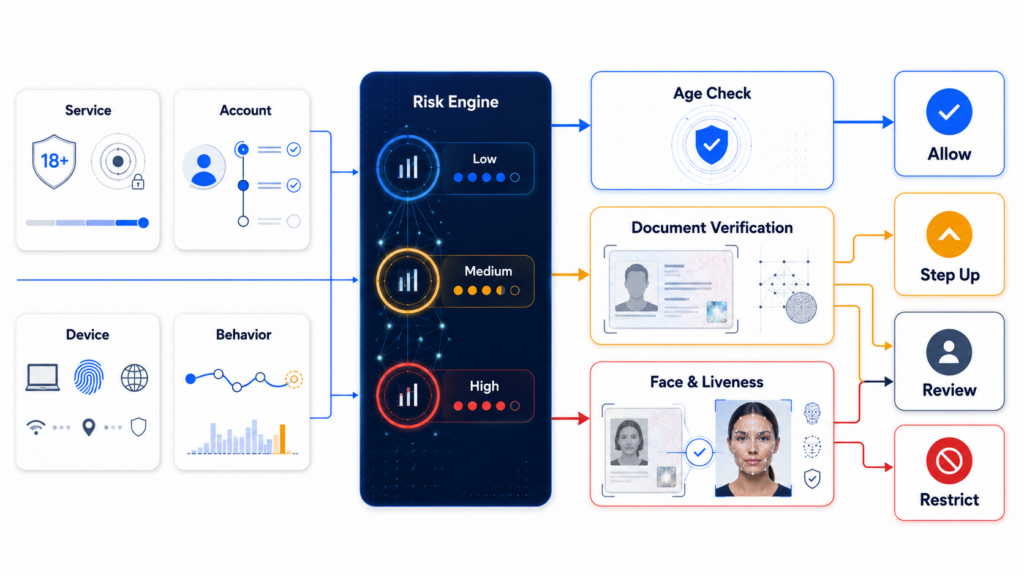
FinAuth Risk Engine brings document, biometric, device, session, behavioral, and business-context signals into one decision workflow.
For example:
- A trusted adult account with consistent activity may continue without interruption.
- An uncertain age claim may trigger document OCR and authenticity checks.
- A document submitted from a suspicious session may require face verification and liveness.
- Manipulated documents, biometric attacks, or repeated circumvention attempts may be reviewed or blocked.
Policies can be configured for different products, markets, and risk thresholds. Through SDK and REST API integration, organizations can apply FinAuth across registration, account recovery, sensitive feature access, and regulated transactions without imposing the same journey on every user.
7. Balancing Assurance, Privacy, and User Experience
A strong workflow collects only the evidence required to reach a defensible decision. Platforms should avoid requesting full identity data when a lower-assurance method is sufficient.
They should also monitor completion rates, retries, step-up frequency, false rejections, review volume, and confirmed underage access attempts. These results can be used to adjust FinAuth risk policies and improve the balance between protection and conversion.
Clear instructions and recovery paths matter as well. Users should be able to recapture a poor-quality document, retry a failed liveness check, or enter review when automated results remain uncertain.
8. Frequently Asked Questions
Q1. What is risk-based age verification?
It is an adaptive age assurance approach that selects verification strength according to service sensitivity, user context, identity evidence, and fraud risk.
Q2. Is age estimation the same as age verification?
No. Age estimation predicts an age range from available signals, while age verification uses evidence—such as a trusted identity document—to determine whether a user meets a required threshold.
Q3. Does document OCR prove a user’s age?
OCR extracts the date of birth, but it does not independently prove that the document is authentic or belongs to the user. FinAuth combines OCR with authenticity analysis and, when needed, face verification and liveness detection.
Q4. Should every user complete full identity verification?
Not necessarily. A risk-based workflow reserves stronger checks for regulated, uncertain, or suspicious cases while allowing lower-risk users to complete a lighter journey.
9. Age Assurance Should Be Proportionate
Effective age verification is not about maximizing friction. It is about matching the strength of evidence to the risk of the interaction.
By combining document verification, face and liveness checks, device intelligence, and multi-signal decisioning, FinAuth helps organizations build age assurance workflows that protect restricted services while preserving privacy and user experience.